
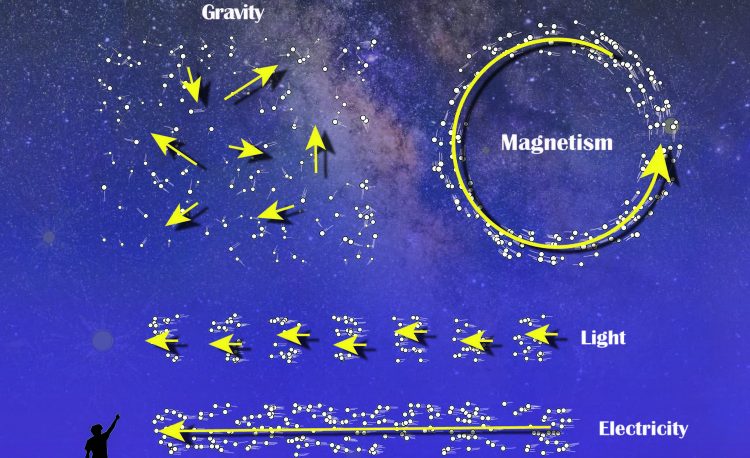
Light, gravity, magnetism, and electricity. Mainstream physics treats these as four very different things, each with its own carrier, its own field, its own set of equations, and in many cases its own department at the university. But step back for a moment and ask a simple question: what do they have in common?
They all travel at the speed of light.
My father, Robert de Hilster, and I have come to believe that this is not a coincidence. If light, gravity, magnetism, and electricity all move at the same speed, then the simplest explanation is that they are made of the same thing: the same particle. The photon, the electron, the graviton, and what we call the “magniton” are not four different particles. They are one particle, and they only differ in the way they move.
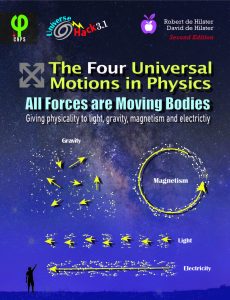
We call these the Four Universal Motions, or 4UM for short. They are the subject of a new website, fourmotions.org, and of the book I am now finishing, The Four Universal Motions in Physics.
A Father and Son Journey
This idea did not come out of nowhere. My father spent over 40 years as an engineer in the telecommunications industry, and in 2006 he led a team trying to show that gravity is caused by a particle, the graviton. Some of that work appeared in my documentary Einstein Wrong – The Miracle Year, and he later wrote about it in his book Gravity is Not Free.
In May of 2015, my father came up with a new way of looking at light: not as a single photon with a “frequency,” and not as a wave in some invisible medium, but as waves of particles traveling together. It was in June 2015 that I first heard him describe it, and it changed the way I looked at everything. Over the next decade, those conversations grew into the four motions.
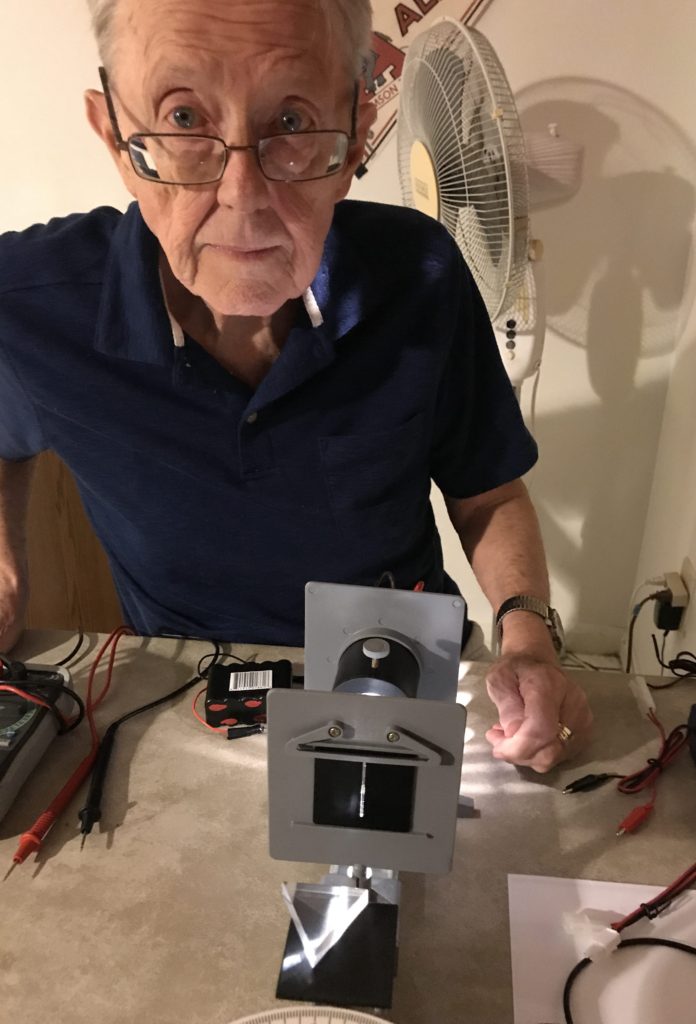

We also stand on the shoulders of others in our community: Dr. Glenn Borchardt and his Infinite Universe Theory, Dr. Ionel Dinu and his underwater experiments on magnetism, and Jeff Yee and his mechanical models at the subatomic level. Many of them are familiar names here on Beyond Mainstream.
The Four Motions
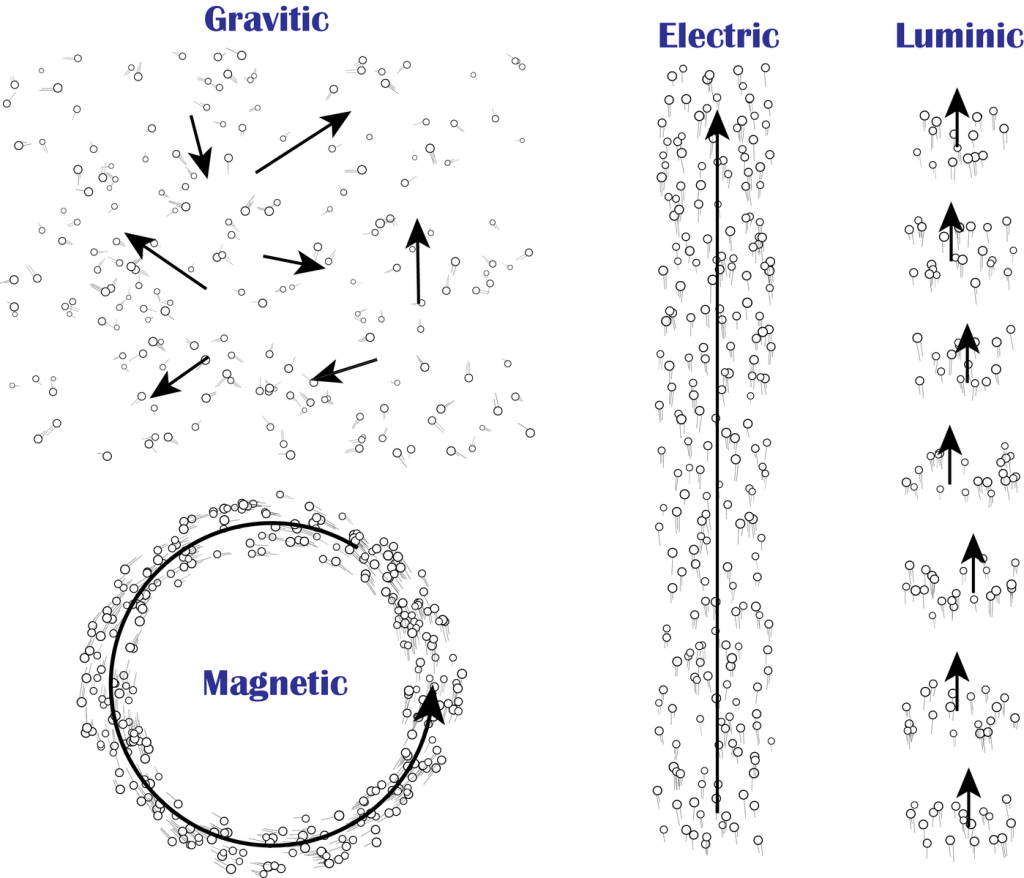
If I had to put the whole model in one sentence, it would be this: gravitic motion is random, magnetic motion is orbits, electric motion is flows, and luminic motion is waves of bodies moving together.
Let’s take them one at a time.
1. Gravitic Motion – Random
Gravitic motion is particles traveling in random directions. It is the most fundamental motion in the universe, and the other three can be derived from it. It may seem strange that the least organized motion is the one that organizes the entire universe, but that is exactly what we propose.
Picture space filled with tiny particles, which we call G1 particles, flying in every direction. Atoms are mostly empty space, so many of these particles pass right through matter, but some hit it. Two bodies near each other “shadow” each other from part of that bombardment, so they get pushed together slightly more from the outside than from the inside. That push is what we call gravity. It is not a mysterious pull at a distance and it is not curved spacetime. It is collisions.
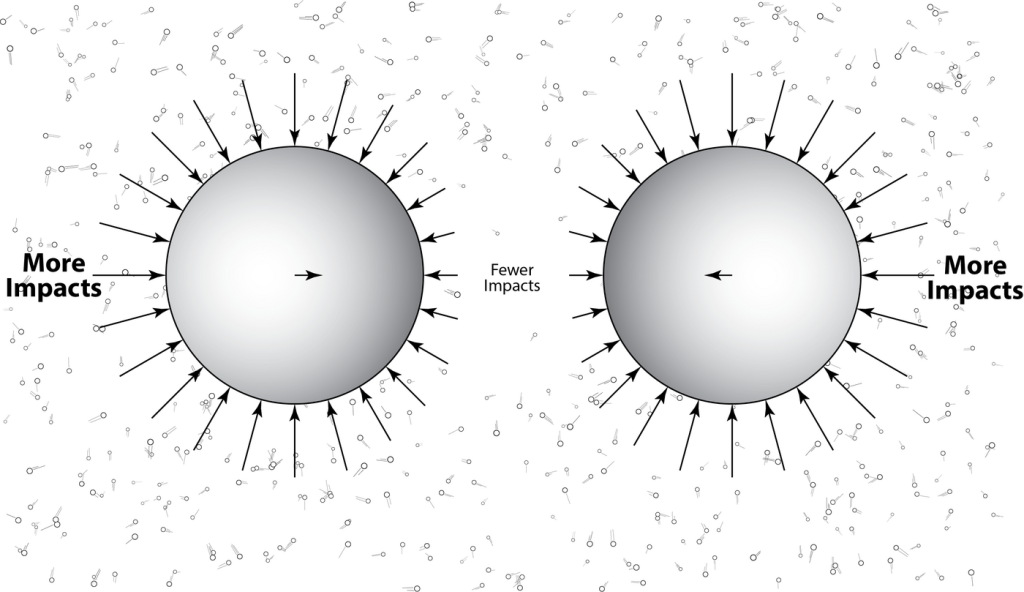
This also answers a question Newton never answered: why does a body in motion stay in motion? Newton’s first law tells us that it does, but not why. In our model, a body moving within a gravitic field keeps moving because of the constant random impacts around it.
2. Magnetic Motion – Orbits
Magnetic motion is what happens when G1 particles are caught in orbits. Think of the atomic nucleus as a sun and the G1 particles as comets circling around it. When two of these circular motions approach each other, they interact: same rotations repel, opposite rotations attract.
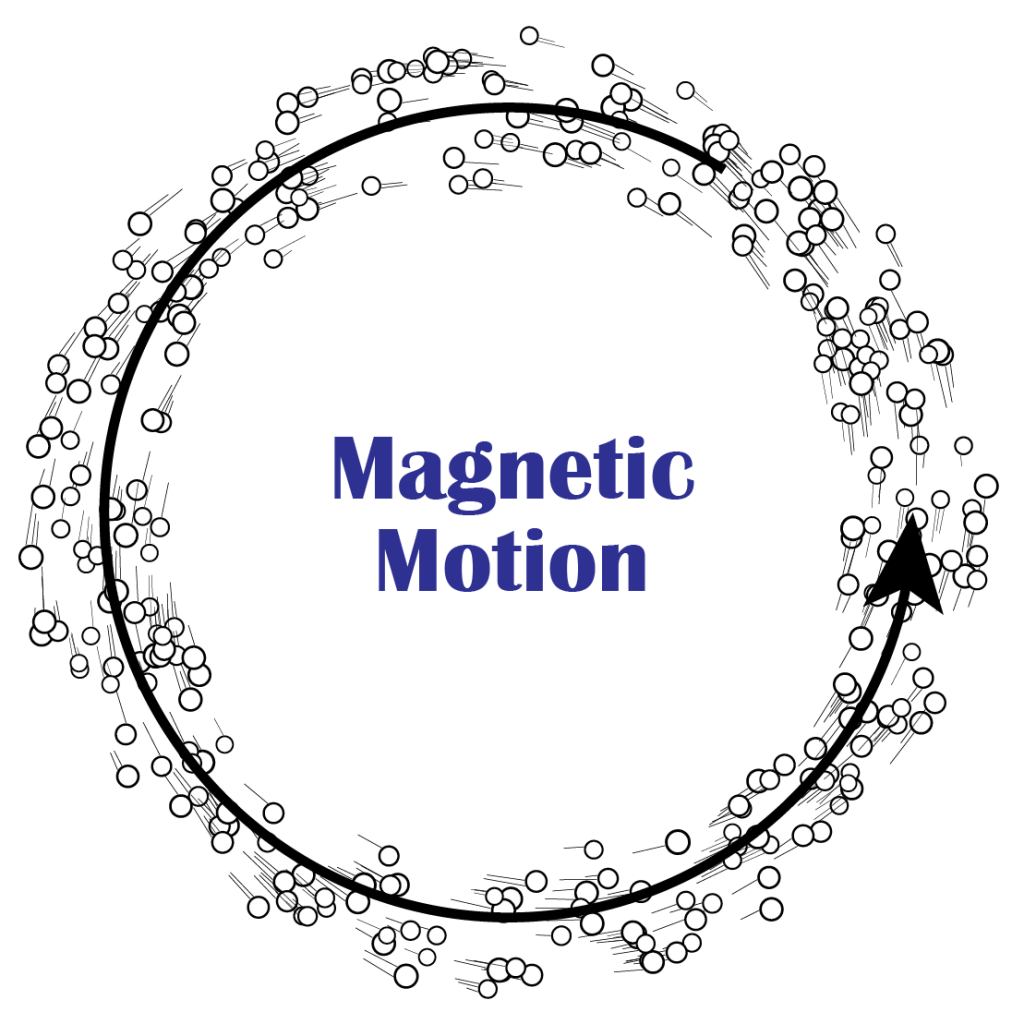
What holds the G1s in orbit? A second, smaller gravity one level down in the universe, caused by what we call G2 particles. This “second gravity” is the gravity of the quantum world, just as G1 gravity is the gravity of the celestial world. You can see this kind of behavior with your own eyes in Ionel Dinu’s underwater cylinder experiments, which we call the Dinu Effect.
3. Electric Motion – Flows
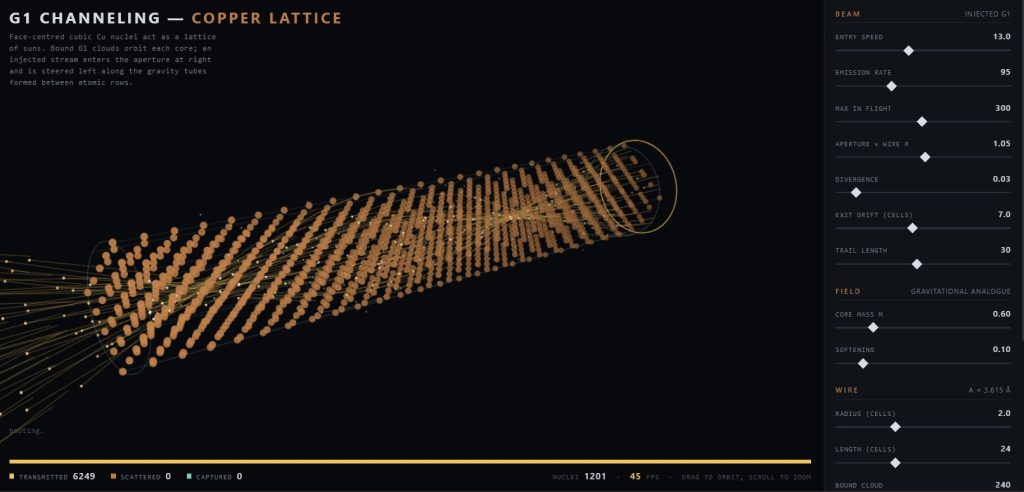
Electric motion is a flow of particles in one direction, along a path that is not an orbit. In a copper wire, the atoms in the metal’s lattice act like guides, channeling G1 particles along “gravitic tubes” through the wire. That flow is what we call electric current.
Notice what is missing: charge. In the four motions, electricity does not need a mysterious property called charge. It needs only particles and the direction they flow in. And because the particles flowing in a wire are the same G1 particles that make up magnetism and light, it is no surprise that a current produces a magnetic field and electromagnetic waves. They are all G1 particles, just moving differently. We even built a live animation of G1 particles flowing through a copper lattice so you can watch it happen.
4. Luminic Motion – Waves of Particles
“Luminic” is a word we invented, because there was no word for this motion. Luminic motion is groups of particles traveling together through space in the same direction at the same speed. It is what we normally call light, or electromagnetic waves.
This takes care of the century-old puzzle of wave-particle duality. Light acts like particles because it is particles. It acts like a wave because those particles travel in groups, and the spacing between the groups is what we measure as frequency. Tight spacing gives us blue and violet. Wide spacing gives us red.
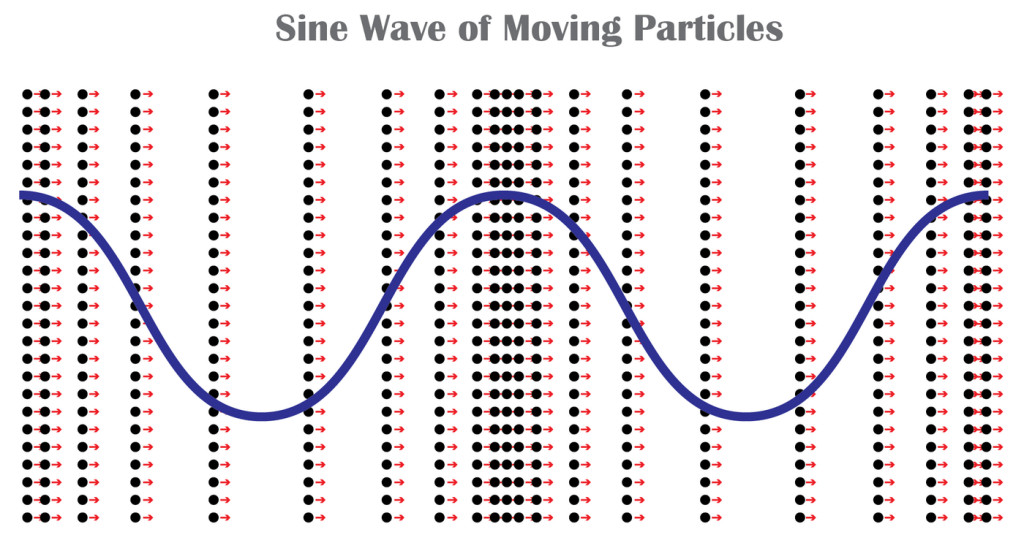
That leads to a conclusion that will surprise many physicists. As I wrote in my recent article The Impossible Photon, a single photon cannot have a frequency, any more than a single bus can have a schedule. One bus has no frequency. Frequency only exists when there is a series of buses. One particle has no frequency, and no size will give it one.
Physics You Can See
Readers of Beyond Mainstream know my feelings about equations. Equations can describe what nature does, but they are not physical. They do not tell you what is actually happening. A great deal of modern physics has become mathematics dressed up as reality: curved spacetime, wave functions, virtual particles, fields with no physical substance.
The four motions take the opposite approach. My father and I require that all of physics be visualizable, without depending on empirical equations. Every force in the universe comes down to physical collisions between real bodies. You should be able to close your eyes and picture what is happening, from the infinitely large to the infinitely small. That is what natural philosophy was always meant to be, and it is what I learned from my mentor, Dr. Ricardo Carezani.
This does not mean we throw away the equations. The equations that work, work because they describe what these motions do. We believe they can be derived from the four motions, which gives them a physical foundation they never had.
Learn More
This article is just an introduction. Over the coming months I plan to write more here on Beyond Mainstream about each of the motions and what they explain, from induction and batteries to transistors and white light. In the meantime, you can explore:
- fourmotions.org: the main site, with pages on each motion and simulations
- The Four Motions video series on YouTube
- Robert de Hilster’s white papers, where the luminic model began
- An Evening with Newton, a dialogue on the four motions
Gravity, magnetism, electricity, and light. One particle, four motions. I think it is one of the simplest ideas in physics, and simple ideas are usually the ones worth taking seriously.

About the Author