Problems in Mainstream Science
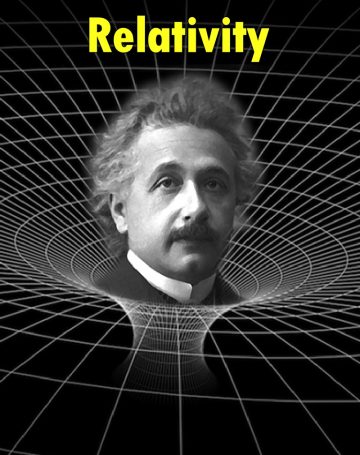
Einstein proposed two theories of relativity: special relativity and general relativity.
Einstein is the inspiration for the “mad scientist”, and admitting that the scientific genius of our age is wrong is not easy to swallow. But as Dr. Cynthia Whitney says, “All theories must be questioned now and then, and now it is his turn.”
And questioned it has been. Relativity is the most argued-over subject in dissident science. This page is your map of the whole fight, and a deep dive into the theory that made Einstein a superstar: general relativity.
What the mainstream says
Special relativity came first, in 1905. Einstein stated that nothing can go faster than the speed of light, and that anyone measuring the speed of light must always get exactly the same answer, no matter how fast they are moving relative to the light source. This then requires that clocks slow down, mass increases, and lengths contract as someone approaches the speed of light. The mathematics that does this is the Lorentz transformation. Einstein never told us WHY these things happen; he stated that they just “are”.
General relativity, published in 1915, is what launched Einstein into superstardom. It says planets and stars bend something called “space-time”, and that this bending is the reason gravity exists. It rests on the equivalence principle: the idea that, locally, falling in gravity and floating free cannot be told apart. Its most famous prediction is that gravity bends light; others include the shift in Mercury’s orbit, the gravitational redshift of light, gravitational waves and black holes. In mainstream physics, both theories are considered among the best-confirmed in all of science.
The problems
Critical thinkers and the science woke community have written thousands of scientific articles and books on how both special and general relativity are not only flawed conceptually and mathematically, but are also contradicted by evidence. One German documentation project alone, G O Mueller, catalogued 3,789 publications criticizing special relativity between 1908 and 2003, by around 1,300 named critics.
The critics don’t all agree with each other. Some want to bring back a preferred frame or an aether and keep Lorentz’s math. Others want to return to Galileo’s simpler picture of motion. Here are the big problems: special relativity in brief, then general relativity in depth.
1. Each clock slower than the other?
If each of two moving clocks runs slow compared to the other, which one has actually lost time when they meet again? Herbert Dingle, once president of the Royal Astronomical Society, pressed this question for two decades. John Chappell argued in Simultaneity Cannot Possibly be Relative to Motion that Einstein’s famous moving-train thought experiment reaches “relative simultaneity” only by contradicting itself. Critics add that clock synchronization is a convention, not a discovery. We cover this fight in detail on our Relativity Problems page and on our Time page.
2. Lorentz’s math, Einstein’s story
The equations of special relativity were not Einstein’s. FitzGerald and Hendrik Lorentz proposed length contraction to explain the Michelson–Morley result, Lorentz reached the full transformation by 1904, and Henri Poincaré named it after him. For Lorentz, shrinking rods and slow clocks were real effects of motion through an aether. Einstein kept the equations, threw out the aether, and turned physical effects into properties of space and time.
Critics attack the equations too. Hartwig Wolfgang Thim lists Three Major Inconsistencies of the Lorentz Transformations. Georg Galeczki sums up his view in a title: Dynamic Gamma Factor: Yes; Lorentz Transformation: No.
3. The experiments that started it all
Relativity was born from the Michelson–Morley experiment of 1887, taught as the “null result” that killed the aether. Critics say the result was never zero, and Dayton Miller, who repeated it for more than thirty years, reported a small, systematic signal. The Sagnac effect, which GPS must correct for, shows light’s travel time differing every day. And the clock record is disputed, from Louis Essen’s verdict that relativity is “not a theory” to Alphonsus G Kelly‘s re-examination of the Hafele–Keating data. Our Light page tells this story in full.
4. The equivalence principle: GPS says no
General relativity stands on the equivalence principle. Tests of the “weak” version (all bodies fall alike) are extremely precise: the MICROSCOPE satellite found no violation to about one part in a million billion. But Einstein’s stronger version says all of physics is the same in free fall as far from any mass, and that is where critics dig in.
GPS engineer Ron Hatch argues in Using GPS to Refute the Equivalence Principle (2010) that operational GPS data contradicts the principle. James Carter counts five different readings of the Pound–Rebka experiment in Just Which Equivalence Principle Do You Believe In?, each giving the principle a different meaning. Stewart Ian Wells argues the famous tests of general relativity do not test the principle at all. And Ionel Dinu charges in Why No Theory Based On Einstein’s Principle Of Equivalence Can Tell What Gravitation Is that it “purposely blurs the distinction between gravitation and inertia”.
5. Mercury’s orbit: the number came first
Mercury’s orbit slowly swings around the Sun, and after every known Newtonian effect is subtracted, about 43 arcseconds per century is left over. Le Verrier noticed the leftover in 1859 and proposed a hidden planet, Vulcan, which was never found. In 1915 Einstein derived exactly 43 arcseconds from general relativity, with no adjustable parameter. It was the theory’s first success.
The awkward fact, documented in Perihelion Precession of Mercury, is that Paul Gerber got the same coefficient in 1898, seventeen years earlier, by assuming gravity travels at a finite speed. His critics, von Laue among them, argued his reasoning does not hold together, but that he got the number first is not in doubt. Others now reach 43 arcseconds without curved space-time: Ernest W Graham with one simple non-relativistic formula that also fits the binary pulsar PSR 1913+16, and Thierry De Mees from the Sun’s motion through the galaxy, though he openly admits choosing the Sun’s speed to hit the target. If different physics gives the same 43 arcseconds, critics ask, how much does the number prove?
6. The 1919 eclipse and the bending of light
Einstein’s fame came from the 1919 announcement that eclipse photographs confirmed light bending around the Sun. Ian McCausland argues in Anomalies in the History of Relativity that it was later realized the observations were not accurate enough to count as a reliable confirmation. Paul Marmet notes in The Deficient Observations of Light Deflection Near the Sun that Eddington’s expedition used a four-inch telescope with a theoretical resolution of 1.25 arcseconds, yet reported some displacements of the order of 0.01 arcseconds. Roberto A Monti says flatly that the eclipse never proved general relativity.
And if light does bend near the Sun, is gravity doing it? Dr. Edward Dowdye argues the bending happens only at the Sun’s thin plasma rim, which is what refraction would do, and not out in the vacuum where gravity should still act. See our Light page for more.
7. What does gravitational redshift really show?
Clocks lower in a gravity field run slower, and the Pound–Rebka experiment of 1959 measured the matching frequency shift up a 22.5-metre tower at Harvard. Popular accounts say a falling photon gains energy. Hatch argues in Gravitational Energy and the Flatness Problem that the photon’s energy is unchanged and the experiment only compared it with a lower reference frequency, and concludes that gravity does not act on all forms of energy. In his paper on clock behavior he adds that special and general relativistic clock effects sometimes cancel and sometimes add, which cannot be coincidence, yet neither theory explains why.
Vyacheslav N Streltsov argues in Gravitation: Frequency Shift vs. Lensing that the measured frequency shift and gravitational lensing exclude each other. To be fair, the wiki’s own reviews note that general relativity also treats Pound–Rebka as a comparison of clocks at different heights; the dispute is over what follows.
8. Binary stars and Kepler’s law
About a dozen close binary star systems were chosen by astronomers as tests of general relativity, because their orbits slowly swing around like Mercury’s. Joe Alexander Nahhas, the most prolific contributor to this literature, argues the theory failed each of them. For SW Canis Majoris he claims his formula gives a 12,017-year cycle against an observed 12,000, where he puts the relativistic prediction at 14,000.
Jerry Hynecek finds a different crack in The Correct Derivation of Kepler’s Third Law (2015): the Schwarzschild metric gives exactly the same Kepler law as flat-space Newtonian physics, which he says exposes a problem for the metric and the theory.
9. Black holes and infinities
General relativity predicts points of infinite density, and critics say a theory that returns an infinity has broken. Stephen Crothers argues that the solution usually credited to Karl Schwarzschild is really a later form due to David Hilbert, and that neither Schwarzschild’s original nor Droste’s solution contains a black hole. Paul Marmet argued in Relativity and the Formation of Black Holes (1990) that, by general relativity’s own clocks, infalling matter would not have had time to cross the Schwarzschild radius in the age of the universe. We cover this on our Black Holes page.
10. Never reconciled with the quantum
General relativity and quantum mechanics have never been joined. Mainstream physicists call this an open problem; several critics call it evidence against general relativity. Streltsov argues in The Incompatibility of General Relativity with Quantum Mechanics (2004) that atomic-clock experiments prove the two cannot both be right. Evert Jan Post, in A Dutch Uncle’s Tirade about Relativity Matters, blames the establishment for watering down general covariance and argues that a refinement of it would solve the problem. See also our Quantum Mechanics page.
Alternative explanations
The critics offer more than criticism, and their alternatives often clash. The neo-Lorentzians keep the equations and restore a preferred frame: Franco Selleri argued in Recovering the Lorentz Ether that his transformations explain the data better than special relativity, without its paradoxes.
Others keep Galileo’s rules of motion and change electrodynamics instead. Parry Moon and Domina Eberle Spencer argued in The New Electrodynamics and its Bearing on Relativity that when the aether fell, Einstein simply took the other fork. Charles and Joseph Lucas obtain the “relativistic effects” from the self-fields of particles with real size.
For gravity, many want classical physics instead of curved space-time. Thomas Barnes argued in Another Theory of Gravitation that all three classic tests follow from conventional physics, and built a theory on the pattern of Maxwell’s equations; De Mees develops gravitomagnetism along the same lines. Dowdye’s Extinction Shift Principle offers classical answers to light bending, redshift and Mercury’s orbit. See also our Gravity page.
Finally, some replace relativity outright: Ricardo Carezani’s Autodynamics, Steven Bryant’s Modern Mechanics, and Tuomo Suntola‘s dynamic space, in which absolute time and distance return.
Critical thinkers working on this problem
- Dr. Cynthia Whitney: an MIT physics PhD in relativity who became one of its critics, working on Galilean electrodynamics.
- Ron Hatch: a principal GPS algorithm designer who argues GPS supports Lorentz’s aether theory over Einstein’s and refutes the equivalence principle.
- Ricardo Carezani: replaced special relativity with “autodynamics”, in which the neutrino is unnecessary.
- Steven Bryant: his Modern Mechanics argues time dilation and length contraction come from mixing up length and wavelength, set out in “Disruptive: Rewriting the Rules of Physics”.
- Stephen Crothers: challenges the mathematics of general relativity and black holes.
- Dr. Edward Dowdye: uses observational analysis to argue gravity does not bend light in empty space.
- Nick Percival: takes on special relativity head-on through the twin paradox and time.
- Harry Hamlin Ricker III: critic of special relativity who wrote commentary on Louis Essen’s letters about it.
- Dr. Alexander Unzicker: explores Einstein’s own idea of a variable speed of light.
- Ionel Dinu: argues the equivalence principle blurs gravitation and inertia, so general relativity cannot say what gravity is.
- James Carter: showed the Pound–Rebka result fits five different readings of the equivalence principle.
- Dr. Charles William Lucas: derives “relativistic effects” from the electrodynamics of finite-sized particles.
Further reading on the CNPS Wiki
- Relativity: the hub for the whole critical literature, strand by strand
- General relativity: the theory and the criticisms collected against it
- Lorentz transformation: the math, its history, and its challengers
- Equivalence Principle: the foundation of general relativity, and the case against it
- Perihelion Precession of Mercury: the 43 arcseconds, and Gerber’s 1898 derivation
- Michelson–Morley experiment: the “null result” that critics say was never null
- Using GPS to Refute the Equivalence Principle: Hatch’s case from satellite data
- Anomalies in the History of Relativity: McCausland on the 1919 eclipse
- The Deficient Observations of Light Deflection Near the Sun: Marmet on telescope limits
- Gravitation: Frequency Shift vs. Lensing: Streltsov’s clocks-versus-lensing argument
- Relativity and the Formation of Black Holes: Marmet on matter that never arrives
- The Incompatibility of General Relativity with Quantum Mechanics: Streltsov’s atomic-clock argument
- 95 Years of Criticism of the Special Theory of Relativity (1908-2003): the G O Mueller catalogue
Read more on the CNPS Wiki.