

Scientist Profile
“Disruption” is a very popular term in business today. It means a new company comes along with a new system that revolutionizes a traditional business once thought to be “undisruptable”. Steven Bryant has taken that same concept and applied it to – wait for it – the theory of relativity!
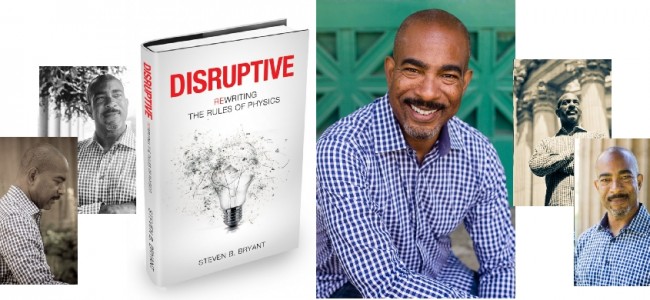
In his book Disruptive: Rewriting the Rules of Physics, Steven takes on Einstein himself to clearly lay out what he sees as the mistakes in relativity, and corrects them with what he calls “Modern Mechanics“.

Background
Steven B. Bryant is an experienced business executive. He began his career in technology, joining Science Applications International Corporation’s software engineering team after completing a BS in Computer Science (with a minor in Psychology) at San Diego State University. After earning his MBA at the University of San Diego, he joined Accenture, where he pursued mastery in two areas: technology and business.
He went on to serve as Vice President of Consulting Services at the San Francisco systems integrator Primitive Logic and as president of the consultancy Avitel, before joining Wells Fargo as a Senior Vice President leading a strategic global initiative. More recently he has worked in artificial-intelligence strategy and governance, and returned to study computer science, specializing in machine learning, at the Georgia Institute of Technology. He lives in the San Francisco Bay Area with his wife and daughter.
Steven is not a physicist by training and doesn’t claim to be. His point is that the problems he has found are mathematical and definitional, so anyone willing to follow the derivations can check them.
How It Started
Steven began examining relativity in the mid-1990s. As he tells it, colleagues at lunch were brainstorming faster-than-light communication when someone said it was impossible because Einstein said so. Steven asked why Einstein got to make the rules, and was told to go learn some relativity. So he took a course, and, in his habit of re-deriving equations himself rather than taking them on trust, found what he took to be an anomaly in the derivation.
Key Ideas
- The Spherical Wave Proof. Einstein claimed that a light wave that is a sphere in one system is also a sphere in the moving system. Bryant argues the proof only shows the transformed points satisfy the general equation of a sphere, not that they lie on the same sphere. Check the radii, he says, and the points land on multiple spheres.
- Three systems treated as two. He argues Einstein’s derivation really involves three systems (stationary, moving and the ray of light) but treats it as two, and that the leftover quantities show up as length contraction and time dilation.
- Length versus wavelength. On Bryant’s account, time dilation, length contraction and the twin paradox all come from using a length-based model to interpret wavelength-based observations. Fix that, he says, and all three disappear.
- The classic experiments. Re-reading the Michelson-Morley and Ives-Stilwell experiments with his equations, he reports results he claims are better than one hundred times more accurate than the Einstein-Lorentz equations.
He has also argued that E = mc² is not unique to relativity: his own equations, expanded and truncated the same way Einstein’s were, give the same first term, so every experiment supporting it supports his model equally well.
His framework went through several names, from the “Complete and Incomplete Coordinate Systems” model of his 2007–2008 papers to the “Physics 3.0” framework in 2010, before reaching its present form as Modern Mechanics in Disruptive (2016). Key papers include “The Failure of the Einstein-Lorentz Spherical Wave Proof” (2010) and “Failure of the Relativistic Hypercone” (2011), written with Glenn Borchardt.
In 2023 his two careers met. In a paper in the peer-reviewed journal Discover Artificial Intelligence, he used his relativity objection as a case study in working with the AI model GPT-4 as a research partner. He reports that the model was initially biased toward defending Einstein, but went on to confirm the inconsistency he had identified.
Recognition
Steven was a subject matter leader in the relativity community of the Natural Philosophy Alliance, has published several papers on relativity theory, and has spoken at AAAS (American Association for the Advancement of Science) and NPA conferences at universities across the United States. Mainstream physics has not engaged with his critique, and still regards the derivations he attacks as sound.
His blog and book can be found at StevenBBryant.com, and his papers and early research can be found at www.relativitychallenge.com.
Read more on the CNPS Wiki.
