Problems in Mainstream Science
Drop an apple and it falls. Physicists can predict that fall with astonishing precision. But ask them what actually pulls the apple down, what reaches across empty space and grabs it, and the room goes quiet. Gravity is the most familiar thing in physics and, as the CNPS Wiki puts it, the least explained.
Newton gave us the law but refused to give a cause. Einstein replaced the force with curved spacetime, and critics have been asking ever since whether that is an explanation or just a new way of drawing the same motion. Over 1,200 items on the wiki dispute the standard account. Some want a push instead of a pull, some want an aether, and some want to rebuild gravity from electricity.
What the mainstream says
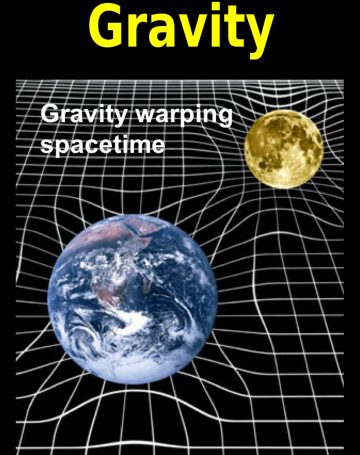
Two accounts hold the field. Newton’s law of universal gravitation says every mass attracts every other with a force proportional to the product of the masses and falling off with the square of the distance. It is accurate enough to land spacecraft. Einstein’s general relativity drops the force altogether: mass and energy curve spacetime, and bodies follow the straightest available paths, called geodesics.
The evidence is strong. Inertial mass (resistance to being pushed) equals gravitational mass to about one part in 1015, and Einstein built general relativity on that equality. The orbit of the binary pulsar discovered by Hulse and Taylor in 1974 shrinks at almost exactly the rate predicted for the emission of gravitational waves. In 2015 LIGO recorded a signal attributed to two merging black holes, and in 2017 a neutron-star merger whose gamma-ray burst followed within seconds.
The problems
1. Newton never gave a mechanism
Newton’s law says how much gravity there is, not what it is. Newton himself found the idea of one body acting on another across empty space absurd. In his 1693 letter to Bentley he called it “so great an Absurdity that I believe no Man who has in philosophical Matters a competent Faculty of thinking can ever fall into it.” Richard Feynman, as quoted by Duncan Shaw, conceded that Newton “made no hypotheses” about the machinery of gravity and that “no one has since given any machinery.”
So the most basic force we experience has a formula but no cause. The wiki’s Instantaneous Action at a Distance article traces how this idea was set aside by field theory rather than ever explained.
2. Curvature is a description, not a cause
A recurring objection, set out on the wiki’s Gravity page, is that a geodesic in curved spacetime describes the motion without causing it. Whether that is a defect or the whole point of the theory is the argument.
Tom Van Flandern pressed the point in Does Gravity Have Inertia? Think of the famous rubber-sheet picture: a ball resting on the side of the dent stays there unless something pulls it, and in the analogy what pulls it is gravity underneath the sheet. The picture, he argued, presupposes what it claims to explain. The wider case against general relativity is covered on our Relativity page.
3. How fast is gravity?
Sunlight arrives from where the Sun was about 8.3 minutes ago. If gravity travelled at the same speed, Van Flandern argued, the Earth would be pulled toward that old position, and the sideways component of the force would double the Earth’s distance from the Sun in about 1,200 years. The orbits are stable. In The Speed of Gravity – What the Experiments Say (1998) he concluded from orbital data and binary pulsars that gravity’s force must travel at least twenty billion times the speed of light, while accepting that gravitational radiation itself travels at light speed.
The mainstream answer, given by relativist Steve Carlip in 2000, is that in general relativity the delay is almost exactly cancelled by velocity-dependent terms, so a light-speed field looks instantaneous. Van Flandern replied that this cancellation is built into the formalism rather than explained physically. The claim is contested even among critics of relativity, and the wiki’s own assessment of the paper sides with Carlip.
4. Gravitational waves and LIGO
LIGO looks for a change in the length of its kilometre-long arms far smaller than a proton. Signals are pulled from the noise by matching them against a bank of theoretical waveform templates, and that is where most criticism aims. Chung Y Lo argues in Einstein’s Equivalence Principle and Invalidity of Thorne’s Theory for LIGO that the waveform theory is not valid. The worry: a search that only finds what its templates describe cannot independently confirm them.
Stephen John Crothers argues in General Relativity – A Theory in Crisis that gravitational waves are inconsistent with general relativity itself, since the energy of the gravitational field is only a “pseudo-tensor”. Raymond H Gallucci, in LIGO – Gravity Waves or Disturbed Aether?, asks how a wave that stretches space could be detected at all when it would stretch LIGO’s own arms along with the light. He suggests LIGO is detecting aether disturbances instead. To be fair, the Gravitational Waves article stresses that the binary-pulsar decay and the 2017 multi-messenger event are the strongest evidence, and that critics have to answer them.
5. Nobody can pin down G
Newton’s gravitational constant, G, sets the strength of gravity. It has been measured for over 200 years, yet laboratory results disagree far beyond their stated errors. According to the wiki, individual results spread over some 544 parts per million, while the official recommended value claims an uncertainty of just 22.
Critics see a clue. Thierry De Mees argues in Fundamental Causes of an Attractive Gravitational Constant, Varying in Place and Time that G depends on where it is measured and where the test materials came from. Frederic Lassiaille proposed in A Specific Measurement of G that G depends on how much matter lies along the line between the masses. The wiki’s own assessment is that the scatter tracks the apparatus rather than the location, pointing to instrument errors such as imperfectly elastic torsion fibres. Either way, the most basic number in gravity remains remarkably hard to measure.
6. What is mass, and why does it resist?
The equality of inertial and gravitational mass is one of the best-tested facts in physics. But as the wiki’s Inertia article says, no accepted theory gives a mechanism. Neither general relativity nor the Standard Model says what physically resists acceleration, or why. In the article’s words, this is “an acknowledged gap and not a manufactured one.”
Ernst Mach argued in the 1880s that inertia comes from a body’s relation to all the other matter in the universe. Einstein named this Mach’s principle in 1918, but came to regard it as not fully realised in his theory.
7. Can gravity be blocked?
If gravity is carried by something, then something should be able to block it. On 30 June 1954 Maurice Allais watched his pendulum swing sharply off course during a solar eclipse, giving “the very definite impression of a screen effect.” The Allais Effect has been fought over ever since, alongside Quirino Majorana‘s gravitational-absorption experiments of 1918 to 1934.
Shielding is the sharpest test of push versus pull, but critics are split. Van Flandern, the best-known push-gravity advocate, listed it among results “discredited or at least made highly dubious” and co-wrote the leading conventional explanation of it, while others, including the Particle Model tradition, see it as evidence of a flux.
Alternative explanations
The oldest alternative is that gravity is a push. In the eighteenth century Georges-Louis Le Sage, developing an idea Nicolas Fatio de Duillier had sketched in the 1690s, proposed that space is filled with tiny, fast “ultramundane corpuscles” streaming in every direction. Two bodies shade each other from the flux and are pushed together. The classic objection, raised by Maxwell and Poincaré, is that such a flux should heat and drag every body it hits. The modern revival is collected in Pushing Gravity: New Perspectives on Le Sages Theory of Gravitation (2002), edited by Matthew R Edwards with a foreword by Halton Arp. Van Flandern built his own version with superluminal “gravitons” and a second medium he called elysium.
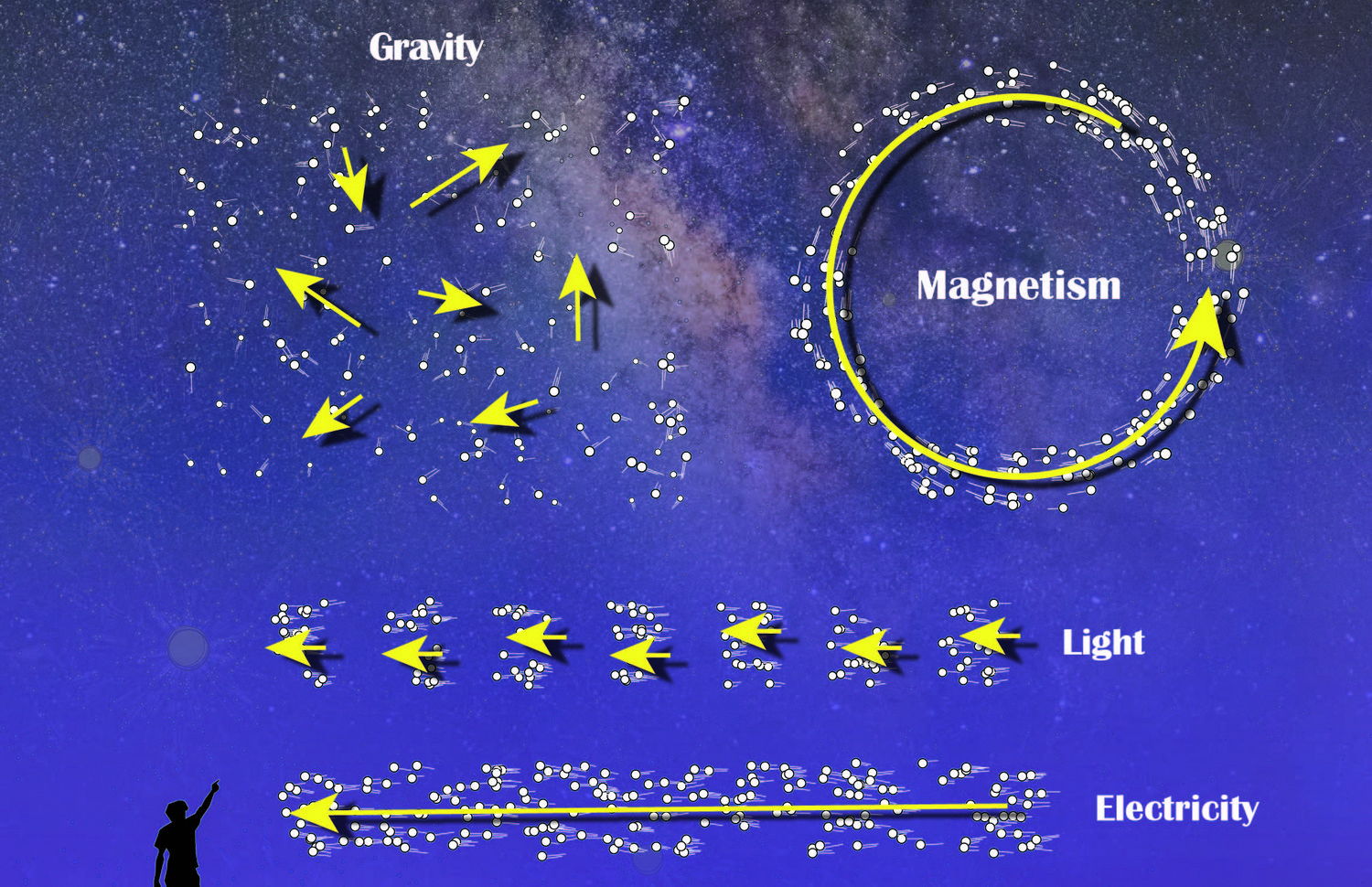
Duncan Shaw argued that gravity is a flowing aether. Matter absorbs a sub-atomic aether, creating a constant inflow toward every body that pushes on anything in its path. Glenn Borchardt and Stephen Puetz, in Neomechanical Gravitation Theory, propose an aether pressure gradient: aether pressure is greatest in intergalactic space and lowest where matter is densest, so bodies are pushed together. They hold that “there are no true pulls in nature.”
Charles William Lucas takes a different route. In Electrodynamic Origin of Gravitational Forces he argues gravity is a tiny statistical leftover of electrical forces between vibrating atomic dipoles, a fourth-order term in v/c. His model predicts that gravity decays over time, which he links to an expanding Earth and to red shifts (see our Redshift page). The wiki’s assessment flags serious difficulties there. Lucas derives inertia from the same force, making the equality of the two masses a result rather than an assumption.
Stoyan Sarg’s BSM-Supergravitation theory fills the vacuum with a “Cosmic Lattice” of sub-elementary nodes, from which both gravity and inertia arise. He predicts that disturbing the lattice around an object changes its gravitational mass, and reports a small laboratory effect he calls SARG. For inertia, others look outward: Relational Mechanics by Andre Assis, and Peter Graneau’s Mach’s Principle & Nonlocal Mass Interactions, treat inertia as a real interaction with the distant universe.
Critical thinkers working on this problem
- Dr. Charles William Lucas: derives both gravity and inertia from his universal electrodynamic force, in The Electrodynamic Origin of the Force of Inertia and related papers.
- Duncan Shaw: retired British Columbia judge whose answer to what physically causes gravity was Maxwell’s aether flowing into matter.
- Dr. Stoyan Sarg: derives gravity and inertia from a lattice structure of the vacuum, and does experimental research on antigravity based on its predictions.
- Dr. Edward Dowdye: argues that light bending near the Sun is refraction in its plasma rim, not gravity, in Gravitational Lensing in Empty Vacuum Space Does NOT Take Place.
- Dr. Glenn Borchardt: explains gravity as a push from an aether pressure gradient, within his Infinite Universe Theory.
- David de Hilster and Bob de Hilster: their Particle Model makes gravity and inertia the result of the same flux of tiny particles.
- Tom Van Flandern (not on our roster): former U.S. Naval Observatory astronomer who argued for a faster-than-light speed of gravity and revived Le Sage push gravity.
Further reading on the CNPS Wiki
- Gravity: map of the whole debate.
- Georges-Louis Le Sage: the father of push gravity.
- Pushing Gravity: New Perspectives on Le Sages Theory of Gravitation: the 2002 collection reviving Le Sage.
- The Speed of Gravity – What the Experiments Say: Van Flandern’s faster-than-light argument, with the mainstream reply.
- Instantaneous Action at a Distance: forces with no delay.
- Gravitational Waves: the evidence and the objections.
- LIGO – Gravity Waves or Disturbed Aether?: Gallucci asks what LIGO really detected.
- Fundamental Causes of an Attractive Gravitational Constant, Varying in Place and Time: why G measurements disagree.
- Allais Effect: the eclipse pendulum anomaly and the shielding debate.
- Inertia: what resists acceleration?
- Mass: what mass actually is.
- Does Gravity Have Inertia?: Van Flandern on why all bodies fall alike.
- Neomechanical Gravitation Theory: Borchardt and Puetz’s aether pressure gradient.
- Electrodynamic Origin of Gravitational Forces: Lucas on gravity as residual electrodynamics.
- A New Approach for Study of Gravity and Inertia from the Point of View of BSM-Supergravitation Unified Theory: Sarg’s vacuum lattice.
- Duncan W Shaw: Shaw’s flowing-aether theory of gravity.
Read more on the CNPS Wiki.