
Scientist Profile
OK, so you spent your life judging right and wrong under every human and logical circumstance you can imagine. Why can’t scientific laws also be judged and weighed? And who better to do that than a lawyer and retired Supreme Court justice?
Duncan Shaw developed an aether theory for light and gravity that was inspired in part by the weather in his beautiful hometown of Vancouver, Canada. There, Duncan noted that mists condensed into rain and then returned to the sky in a never-ending cycle.
This cycle inspired David de Hilster to dub Duncan’s aether theory the “Vancouver Aether.”
Background
Duncan Weld Shaw was born in Vancouver on November 21, 1932. He earned a B.A. (1955) and a law degree (1956) from the University of British Columbia, learned to fly along the way, and served as a pilot in the Royal Canadian Air Force reserves until 1964.
For nearly thirty years he was a trial lawyer at the Vancouver firm Davis & Company, rising to head its litigation group. He was appointed Queen’s Counsel and elected a Fellow of the American College of Trial Lawyers. In 1987 he became a Justice of the Supreme Court of British Columbia, where he sat for twenty years and made one of Canada’s most debated constitutional rulings. He even mastered French well enough to be one of the few judges in the province able to run trials in that language.
The CNPS Wiki points out that he brought the same habit of mind from the courtroom to physics: he wanted a claimed effect to be shown by evidence, and would not accept a conclusion simply because it was widely held.
Duncan died in Vancouver on March 24, 2025, at the age of 92, after 64 years of marriage to his wife Pat.
Key Ideas and Work
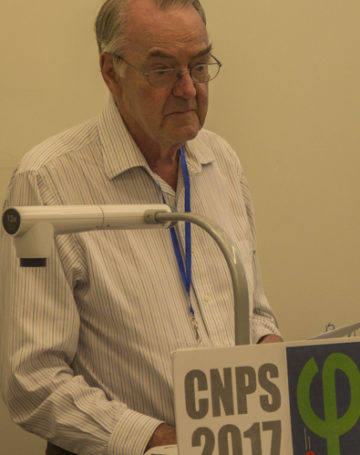
Ever since high school, Shaw had wondered what physically causes gravity. “The idea that gravity may be caused by ‘instantaneous-action-at-a-distance’,” he wrote, “never made sense to me.” Near the end of his time on the bench he decided to find out. He read everything on gravity he could find, corresponded with researchers around the world, and from 2009 to 2019 was a regular at the Natural Philosophy Alliance and CNPS conferences and online discussion groups. His first paper, in 2009, opens simply: “I am a retired Judge of the British Columbia Supreme Court.”
His starting point: “My basic assumption is that there are mechanical explanations for the various phenomena of physics.” Forces must work by direct contact, not by pulling across empty space, an idea he took from Newton himself. For his mechanism, Shaw turned to James Clerk Maxwell‘s 1865 aether, an elastic medium filling space. He argued this aether was abandoned rather than disproved, and that it is a real substance made of structured, elastic sub-atomic cells.
Here is how his “flowing aether” works:
- Gravity is a push. Matter absorbs aether, so aether flows continuously inward toward every planet and star, pushing on whatever is in its path. He compared it to a trout holding still in a flowing stream.
- Rain in space. The inflowing aether is condensed into liquid-like droplets. Inside bodies it vaporizes, and the gas flows back out to space, where it condenses again, just like evaporation, clouds and rain. Because the incoming droplets are much bigger, they hit atoms far more often, which is why gravity only pulls one way.
- Electricity and magnetism. Electric current is a chain of collisions between aether cells along a wire, and a squeezed elastic cell bulges sideways, which he saw as the simple mechanical reason magnetic fields circle a current.
- Entanglement. The aether fills the whole experiment, so distant detectors aren’t talking to each other at all; each simply reads the state of the aether right next to it.
Shaw published his main papers in the peer-reviewed journal Physics Essays, including “The Cause of Gravity: A Concept” (2012), “Flowing Aether: A Concept” (2013), “Outflowing Aether” (2016) and his last major paper, “On Maxwell’s 1865 Theory of Aether: A Step Toward Unity” (2020). He also wrote on inertia and the structure of atoms, and visited CERN.
He was refreshingly candid about the limits of his work, calling his results “strictly conceptual” and offering them as a concept for others to develop rather than a finished theory. Fellow critical thinker Dr. Raymond Gallucci, who makes a habit of testing other dissidents’ ideas, has assessed Shaw’s aether concept of gravity.
Recognition
The CNPS Wiki calls his work unusually well presented: he stated his assumptions plainly, argued from them in order, quoted his opponents accurately and did not overclaim. As the wiki puts it, a retired judge applying a lawyer’s discipline about evidence produced a body of work accepted by a peer-reviewed physics journal, and that is notable in itself.
Read More
You can read more about Duncan and his work:
Read more on the CNPS Wiki.
