Problems in Mainstream Science
Light is the most ordinary thing in the universe. Yet ask a physicist what light actually is, and what it travels in, and the honest answer is a shrug dressed up as a slogan: “it’s both a wave and a particle.”
Critical thinkers aren’t satisfied with that. The CNPS Wiki collects some 260 papers on light, and they argue about almost everything: whether there is a medium, whether the famous “null” experiment was null, whether the speed of light is really constant, whether the photon exists, and even whether gravity bends light at all. They don’t agree with each other, but they all refuse to accept “you may not ask further” as an answer.
What the mainstream says
In the standard picture, light is an electromagnetic wave: coupled electric and magnetic fields oscillating together, as predicted by Maxwell’s equations. In a vacuum it travels at c, about 299,792,458 metres per second. Since 1983 that number is no longer measured at all; it is defined, and the metre is derived from it. Light is also quantized. It is emitted and absorbed in packets called photons, each with energy E = hf and zero rest mass.
There is no medium. The textbooks teach that the 1887 Michelson–Morley experiment found no “aether wind”, and Einstein’s 1905 postulate that light has the same speed for every observer, whatever their motion, dispensed with the aether altogether. (For what follows from that postulate, see our Relativity and Relativity Problems pages.)
The modern mainstream doesn’t treat wave–particle duality as an open paradox. Light is neither a classical wave nor a classical particle; it is an excitation of a quantum field, and one consistent set of equations has described it since 1926. And general relativity predicts that gravity bends light, which mainstream astronomy regards as confirmed on scales from the Sun to distant galaxy clusters.
The problems
1. A wave of what?
A wave is a disturbance of something. So what is waving when light crosses empty space? David de Hilster argues that the familiar textbook drawing of two perpendicular sine waves is “a graph of a mathematical relationship dressed up as a physical object.” It never says what is being displaced, or what links the two fields. The leap to “light is an electromagnetic oscillation”, he says, rested on a numerical coincidence of speeds.
Cynthia Whitney traces the same gap to 1905: Einstein, she argues in “SRT: About That Light in the Beginning“, sidestepped the question of what was waving and focused on the speed instead. The full debate is on the wiki’s Light page.
2. The “null result” was never null
Michelson and Morley expected a shift of about four-tenths of a fringe. They saw far less, but not nothing. Morley’s collaborator Dayton C. Miller, later president of the American Physical Society, kept measuring for more than thirty years. From Mount Wilson he collected over two hundred thousand readings and reported a drift of roughly 10 km/s whose direction varied with sidereal time. His result was not refuted in his lifetime; it was set aside, and in 1955, after his death, a reanalysis blamed temperature gradients. Researchers on the wiki regard that verdict as inadequate.
Others question what the experiment could test in the first place. Lori Gardi argues in “Michelson Morley Experiment: A Shocking Revelation” that moving through a still medium is not the same as having a medium blow past you, just as a convertible on a still day feels a wind that isn’t blowing.
3. If Sagnac, why not Michelson–Morley?
Light-speed differences are detected routinely, just not in the case the textbooks cite. In the Sagnac effect, first shown in 1913, two beams sent opposite ways round a rotating loop arrive at different times. Ring-laser gyroscopes depend on it, GPS must correct for it, and the 1925 Michelson–Gale experiment used it to measure the Earth’s rotation. Howard Hayden and Cynthia Whitney put the obvious question in the title of their 1990 paper: “If Sagnac and Michelson-Gale, Why Not Michelson-Morley?“
The mainstream reply, going back to Paul Langevin, is that a rotating apparatus isn’t an inertial frame, so relativity predicts the effect. Whitney spent a decade at Draper Laboratory, fresh from an MIT doctorate in special relativity, defending that reply to engineers building ring-laser gyroscopes. In her own words: “I argued for a whole decade. And I lost.”
4. Constant, or only measured that way?
Almost every measurement of c is a round trip: out to a mirror and back. Measuring the true one-way speed needs two separated, synchronized clocks, and synchronizing them already assumes an answer about how light travels. The mainstream calls this a harmless convention; the critics on the wiki’s Speed of Light page don’t. Paul Marmet argues in “Explaining the Illusion of the Constant Velocity of Light” that light really moves at c − v or c + v relative to a moving observer, and calls the apparent constancy “the most fascinating illusion in science.”
GPS is the everyday laboratory. Ruyong Wang and Ron Hatch argue that GPS shows light keeping speed c relative to the Earth-centred, non-rotating frame, but not relative to a receiver moving within it. Stephan Gift goes further in “Faster West than East“, concluding that light travels faster westward than eastward relative to the Earth’s surface. Others, following Barry Setterfield in “The Atomic Constants, Light, and Time“, argue that c has slowed over the centuries, though since 1983 a discrepant measurement would show up only as a miscalibrated metre.
5. Duality: a contradiction given a name
Light interferes like a wave, yet is absorbed in discrete lumps. Bohr’s 1927 answer, complementarity, said both pictures are needed but never at once. The researchers documented on the wiki’s Wave-Particle Duality page see this as a contradiction given a name rather than an explanation. Some call it a confusion of language; others keep only the wave, or only the particles.
6. Does the photon exist?
Trevor Marshall and Emilio Santos argue in “The Myth of the Photon” that every “single-photon” state in quantum optics can be described with ordinary, unquantized Maxwell waves, with the quantum work done by the theory of the detector. Eric Reiter took the experimental route. He repeated the famous beam-splitter test, which is supposed to show a single quantum can’t be split between two detectors, using gamma rays and then alpha rays. In “A Challenge To Quantized Absorption by Experiment and Theory” he reports coincidences far above chance, which he calls the “unquantum effect”.
David de Hilster attacks the photon by logic. Frequency means “how often”, so it needs a series of events. “One bus has no frequency. One particle has no frequency,” he writes in “The Impossible Photon“. Lori Gardi reaches “no photons” from unit analysis in “Planck’s Constant and the Nature of Light“: she argues Planck’s constant is the energy of one period of light, so every cycle carries the same energy, and the “photon” is just one second’s worth of those quanta.
7. Does gravity really bend light?
Light bending near the Sun is general relativity’s most famous prediction. Paul Marmet, in “The Deficient Observations of Light Deflection Near the Sun“, points out that Eddington’s eclipse expedition used a four-inch telescope whose theoretical resolution, with perfect optics, was about 1.25 arcseconds, while some reported displacements were around 0.01 arcseconds.
Edward Dowdye, a NASA Goddard laser optics physicist, didn’t deny the bending; he disputed its cause. He read the data as showing deflection only at the Sun’s thin plasma rim and not in the vacuum beyond it, the signature of refraction rather than gravity. He added that radio signal delays near the Sun depend on frequency, as a plasma effect would and a gravitational one shouldn’t. Mainstream astronomers reply that lensing is also seen where little plasma is present. See the Extinction Shift Principle, and our sibling page on Gravity.
Alternative explanations
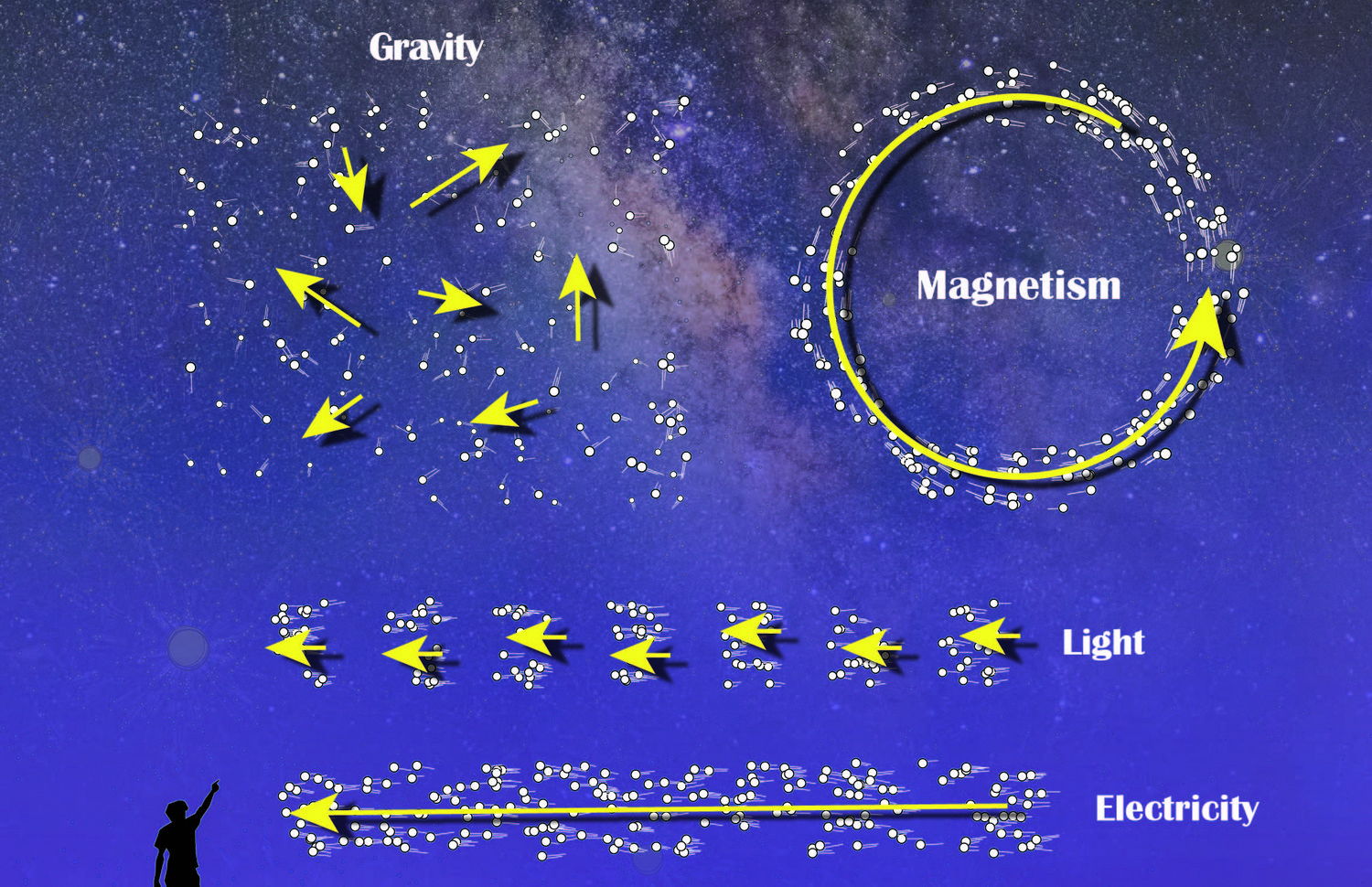
Light as waves of particles. In 2015 Bob de Hilster proposed that light is made of successive groups of real particles travelling together at the speed of light, arriving “like successive waves of bombers,” in his son David’s phrase. Frequency is how often the groups arrive; intensity is how many particles each group holds. There is no duality left to reconcile. David named this “luminic motion”, one of the four universal motions of their Particle Model.
A real medium. Many researchers keep the wave and look for what it travels in. John-Erik Persson argues for an aether entrained by the Earth, and Alphonsus Kelly concluded that the aether moves with the Earth in its orbit but doesn’t rotate with it daily. David de Hilster objects to all of these with his “container problem”: every real medium is held together by some force, and nothing is offered to hold an aether together in open space. See Aether.
Emission theory. Dowdye revived the idea, associated with Walter Ritz, that light leaves its source at c relative to the source, and extended it from electromagnetism to gravitation in his Extinction Shift Principle, which uses only Galilean velocity addition and ordinary Euclidean geometry.
Light speed tied to gravity. Howard Hayden, building on Petr Beckmann, derived how light speed varies with gravitational potential from conservation of energy, and predicted starlight deflection in agreement with general relativity and with measurement, without curved space-time.
Classical waves and thresholds. Reiter argues that light is emitted in quanta but spreads as a classical wave, and that detectors accumulate energy until they cross a threshold, so quantized absorption is an illusion.
To their credit, these researchers police each other. Thomas Phipps warned his own side in “Potier’s Principle: A Trap for Unwary Etherists and Others” that simple optical experiments cannot, even in principle, test certain first-order departures from light-speed constancy.
Critical thinkers working on this problem
- Eric Reiter: his gamma-ray and alpha-ray beam-split experiments report an “unquantum effect” that he presents as an experimental challenge to the photon.
- Dr. Edward Dowdye: author of the Extinction Shift Principle, who argued the Sun’s plasma rim, not gravity, bends starlight.
- Bob de Hilster: proposed in 2015 that light is waves of particles, his solution to wave–particle duality.
- David de Hilster: named “luminic motion”, argues a single photon cannot have a frequency, and criticizes the aether as a model for light.
- Lori Gardi: argues from unit analysis that Planck’s constant is the energy of one period of light, and challenges the logic of Michelson–Morley.
- Dr. Cynthia Whitney: an MIT relativity PhD whose decade with the Sagnac effect led to her own model of light propagation.
- Ron Hatch: argues with Ruyong Wang that GPS shows light speed is not constant relative to a moving receiver.
Further reading on the CNPS Wiki
- Light: the full survey of particle, wave and medium models, and where the researchers disagree.
- Speed of Light: one-way versus two-way speed, GPS, and light speed in gravity.
- Photon: the case against the photon, and the structured-photon alternatives.
- Wave-Particle Duality: the standard account and the many lines of attack on it.
- Michelson–Morley experiment: why critics say the result was never null.
- Dayton C. Miller: thirty years of aether-drift measurements at Mount Wilson.
- Sagnac Effect: the rotating-loop experiment and the dispute over its meaning.
- Aether: the medium proposed to carry light.
- Extinction Shift Principle: Dowdye’s emission theory and plasma-lensing argument.
- Particle Model: the de Hilsters’ particle account of light, gravity and matter.
- The Myth of the Photon: Marshall and Santos on quantum optics without photons.
- A Challenge To Quantized Absorption by Experiment and Theory: Reiter’s “unquantum” experiments.
- Planck’s Constant and the Nature of Light: Gardi’s unit-analysis case against the photon.
- The Deficient Observations of Light Deflection Near the Sun: Marmet on the precision of the eclipse evidence.
Read more on the CNPS Wiki.