
Problems in Mainstream Science
Everything you can touch is made of atoms, and every atom is wrapped in electrons. Electric current, chemical bonds, most of what we call electricity: it all comes down to the electron. So here is a simple question. What is an electron? Critics love to quote Einstein: “I would just like to know what an electron is.” A century later, critics say, physics still can’t tell him.
The official answer is that the electron is a point: zero size, no shape, no insides. Yet that same point is said to spin, to carry mass and charge, and to act like a tiny magnet. And the atom built from these points is described not as a structure you can picture, but as a cloud of probabilities. To many critical thinkers, that is not an explanation at all.
What the mainstream says
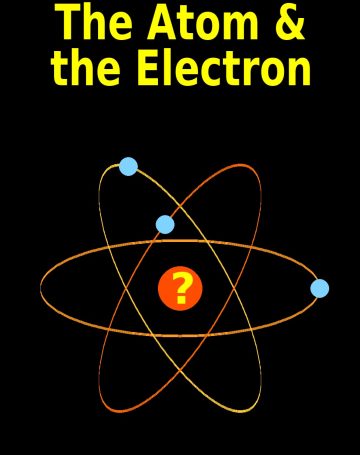
The modern atom was put together in about thirty years. J. J. Thomson identified the electron in 1897. Rutherford’s alpha-scattering experiments, reported in 1911, showed that nearly all of an atom’s mass sits in a tiny positive nucleus, roughly a hundred thousand times smaller than the atom itself. In 1913 Niels Bohr had electrons circling the nucleus in fixed orbits, which reproduced the spectrum of the hydrogen atom. In 1925 and 1926 the wave mechanics of de Broglie, Schrödinger and Heisenberg replaced the orbits with “stationary states”, and Pauli’s exclusion principle explained why electrons stack into shells and give the periodic table its shape.
In today’s Standard Model, the electron is a lepton: a structureless point with charge, spin one-half and a magnetic moment slightly larger than the simple theory predicts (the “anomalous” moment). The proton is not elementary at all, but three quarks bound by gluons, and the strong nuclear force holds the nucleus together.
The record is formidable, and critics concede it. Atomic transition frequencies are predicted and measured to more than ten significant figures. The electron’s anomalous magnetic moment agrees between theory and experiment to roughly twelve significant figures, and scattering experiments show no structure inside the electron down to about 10-20 m. What the theory does not offer is a picture. An electron in an atom has a probability amplitude, not a path.
The problems
The critics rarely say the numbers are wrong. They say no physical object stands behind them. The wider battles are covered on our Particle Physics and Quantum Mechanics pages. Here we stick to the atom and the electron itself.
1. A point that spins
Spin is rotation, and a point has no radius to rotate about. A magnetic moment implies a current loop, and a point encloses no area. Critics argue that charge, mass, spin and magnetic moment are properties only an object with real size can have. David Bergman makes this case in “Modeling the Real Structure of an Electron“, concluding that only a finite-size electron can explain all of them together.
2. Infinite energy, explained away
Squeeze a finite charge into a point and the classical energy of its own field becomes infinite, which by E = mc² would mean infinite mass. The electron’s measured mass is finite. In calculations the infinities are removed by “renormalisation”, subtracting the unwanted terms. And why doesn’t a point of negative charge fly apart under its own repulsion? Common Sense Science quoted standard references calling it “an unsolved mystery”. Critics call this bookkeeping, not explanation.
3. The electron once had a size and shape
In 1919 Arthur Holly Compton published “The Size and Shape of the Electron“. He pointed to two clashes between experiment and a point-charge theory of X-ray and gamma-ray scattering, and found that a thin flexible ring of electricity explained the data better than a rigid or flexible sphere. He concluded the electron has a real size, comparable to the wavelength of the hardest gamma rays. Critics say this ring tradition was abandoned, not refuted, once quantum mechanics took over.
4. Why doesn’t the atom collapse?
Classical electrodynamics says an accelerating charge radiates. An electron circling a proton should spiral in within a fraction of a nanosecond. Bohr’s 1913 model was, as the wiki puts it, “an admitted hybrid”: it simply forbade that radiation by fiat. Quantum mechanics answers by denying the electron has a path at all. Explanation or restatement? That is the dispute.
Randell Mills, in “The Fallacy of Feynman’s and Related Arguments“, argues that the theories of Bohr, Schrödinger and Dirac provide no physical reason for the atom’s stability, attacking Feynman’s textbook uncertainty-principle argument (the wiki’s own assessment defends Feynman on several points). Jan Olof Jonson argues that collapse was never a real problem: if all forces on the electron are perpendicular to its motion, no work is done and no energy is lost.
5. Orbitals are not objects
Textbook “orbitals” are probability clouds, not physical structures. Bergman’s “Electron Wave Function” asks what is actually waving, and argues that the Schrödinger wave function cannot be read as a physical wave. Philipp Kanarev goes further in “Electrons in Atoms“: he argues that the law behind atomic spectra contains no orbital energy at all, so “the concept of the orbital movement of the electron in the atom becomes a myth”. He proposes precessing electrons instead.
6. The “anomalous” magnetic moment
The electron’s magnetic moment is the Standard Model’s showpiece. Critics read the word “anomalous” differently. In the Spinning Charged Ring model of Bergman and Paul Wesley (1990), the factor of two in the electron’s gyromagnetic ratio, which Dirac’s theory supplies formally, falls out of the ring’s geometry. On their view the moment only looks anomalous when measured against a point-particle baseline that was never physical in the first place.
7. Shells by rule, not by mechanism
Why do electrons stack into shells of 2, 8, 18 and so on? Because of the Pauli exclusion principle. But as the wiki notes, the principle is a statement about the symmetry of the wave function, not a force: there is no “exclusion force” anywhere in the equations. Critics are uneasy that a mere rule organises all of chemistry, and several try to derive the shells from geometry instead.
8. A nucleus that needs two models
Positive protons sit packed together in the nucleus despite their repulsion. The standard answer is a separate strong force, now seen as leftover colour force between quarks, though quarks are never seen in isolation. Mainstream physics needs two quite different pictures of the nucleus, the liquid drop and the shell model, and has no first-principles calculation of medium and heavy nuclei from quark theory, which the wiki calls “an acknowledged limitation”.
Alternative explanations
Ring and toroidal electrons. The largest family of alternatives gives the electron the shape of a ring or torus of charge circulating at the speed of light. In Bergman and Wesley’s model, four measured properties fix the ring, which is then reported to be stable under electromagnetic forces alone, with a size equal to the rationalised Compton wavelength. Robert Carroll independently derived “The Toroidal Electron” in 1991 from the wave equation for matter. Glen Collins’s “Helicon” version winds the charge helically around the torus, with the number of turns standing for energy levels.
Lucas’s universal force and the packed atom. Charles William Lucas, a co-founder of Common Sense Science, derived what he calls the universal electrodynamic force for real, finite-size, elastic charged particles, and refined Bergman’s ring into closed toroidal strings. In “A Classical Electrodynamic Theory of the Atom” he packs ring electrons into shells using combinatorial geometry. Instead of point electrons orbiting, stationary ring electrons act as small magnets and bind atoms together electrically and magnetically. Lucas says the model explains why the periodic table has only seven periods, and that NASA rocket probes found 64 extreme-ultraviolet hydrogen lines it predicted. With his son Joseph he extended the packing to the nucleus, claiming the nuclear “magic numbers” and the spins of all nuclides without a separate strong force.
Wave-structure and energy-wave models. Milo Wolff proposed in “Beyond the Point Particle” that the electron is nothing but a configuration of waves, a “Space Resonance”, whose behaviour creates its particle-like appearance. Jeff Yee’s Energy Wave Theory builds on that tradition: a particle is a standing wave in a medium, its stored energy is its mass, and its edge is where the standing wave fades. Yee calculates the electron at ten “wave centers” and reports its energy matching the accepted value.
Particle models. Bob de Hilster and David de Hilster go furthest of all. In their Particle Model there is no electric charge. A nucleon replaces the proton and neutron, a fast “G1” particle replaces the electron and orbits the nucleus, and even faster “G2” particles push the atom together as its binding force. Their later “Four Universal Motions” says the electron, the photon, the graviton and the magnetron are all the same particle in different kinds of motion. On this view there is no separate electron to be shaped at all.
Structured nuclei. Stoyan Sarg’s Basic Structures of Matter theory places the electron in a grid-like physical vacuum and gives protons and neutrons the shapes of a folded and a twisted torus. His atlas of nuclei from hydrogen to uranium, Sarg says, matches the rows and columns of the periodic table. Edo Kaal‘s Structured Atom Model builds nuclei from densely packed protons with electrons between them as “glue”, with no strong force or quarks.
These models disagree with each other as sharply as with the Standard Model, and the wiki is frank that hydrogen’s levels, known to parts in 1012, are the test they must meet. But they share one conviction. A physical theory should say what things are, and an electron you cannot picture has not yet been explained.
Critical thinkers working on this problem
- Dr. Charles William Lucas: universal electrodynamic force and a ring-electron packing model of the atom and nucleus that he says explains the periodic table and nuclear magic numbers.
- Jeff Yee: Energy Wave Theory, in which the electron is a standing wave of ten wave centers in a medium.
- Bob de Hilster: co-developer of the Particle Model, which replaces the charged electron with an uncharged orbiting G1 particle.
- David de Hilster: co-author of the Four Universal Motions, where the electron, photon, graviton and magnetron are one particle in different motions.
- Dr. Stoyan Sarg: physical models of the electron and of atomic nuclei from his Basic Structures of Matter theory.
- David L. Bergman: the Spinning Charged Ring electron and the case against the point particle.
Further reading on the CNPS Wiki
- Electron: the full survey of point, ring, wave and aether models and their criticisms.
- Atom: the standard account and the wiki’s alternative atomic models.
- Hydrogen Atom: Bohr, Schrödinger, the stability problem and the benchmark every model must meet.
- Nucleus: the strong force, the shell and liquid-drop models, and structured alternatives.
- The Size and Shape of the Electron: Compton’s 1919 case for a finite, ring-shaped electron.
- A Classical Electrodynamic Theory of the Atom: Lucas’s ring-electron packing model of the periodic table.
- A Physical Model for Atoms and Nuclei, Part 2: Charles and Joseph Lucas’s nuclear packing model, with a critical assessment.
- Pauli Exclusion Principle: a rule without a force, and attempts to supply a mechanism.
- Energy Wave Theory: Yee’s standing-wave particles and their constants.
- The Four Universal Motions in Physics: one particle, four motions.
- Structural Physics of Nuclear Fusion: Sarg’s torus-shaped protons and neutrons and his atomic models.
Read more on the CNPS Wiki.