

Scientist Profile
You are an American NASA scientist who studied physics in Germany and is fluent in German, and when you read Einstein’s work in his native tongue, you realize that Einstein’s intentions are different from what you read in English textbooks.
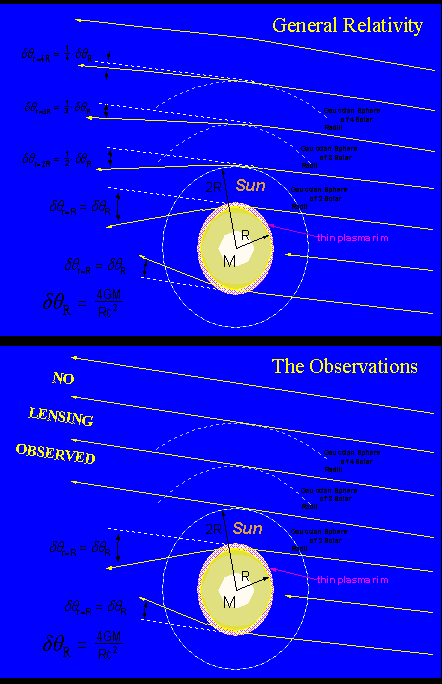
What’s more, when you look at the data for starlight passing near the sun, you notice that the light is only bent when it passes through the sun’s thin plasma rim, and not out in the empty space beyond it, where Einstein’s general theory of relativity predicts it should still bend, at least slightly.
So what do you do? You come to this conclusion: “a direct interaction between gravitation and electromagnetism occurs nowhere in plasma-free space” (see http://www.extinctionshift.com). That’s a fancy way of saying, “Einstein: your prediction of gravity bending light, the one that made you world famous, is incorrect.”
Why doesn’t NASA know about these findings? To put it simply, no one wants to be the first to say Einstein’s theory as modern science interprets it is wrong. That would upset too many apple carts, as Neal Adams would say.
Background
Edward Henry Dowdye, Jr. (November 13, 1943 – December 31, 2020) was born in Washington, D.C. He earned B.S. degrees in mathematics and electronics technology, with further study in physics, at Hampton University in Virginia. He then earned the Diplom-Atomphysik (Atomic Physics) at the Physikalisches Institut der Universität Heidelberg in Germany, supported by the German Academic Exchange Service. There he researched nuclear magnetic resonance using optical pumping on free atoms and ions, studied astronomy and astrophysics, taught experimental physics and mentored German graduate students. He later received his Ph.D. in laser spectroscopy physics from Howard University in Washington, D.C., in research supported by NASA. He was fluent in German and Spanish and also spoke French.
At NASA Goddard Space Flight Center in Greenbelt, Maryland, Dowdye worked as a laser optics physicist and electronics engineer on satellite-borne laser systems, testing precision optics and the non-linear crystals used to generate harmonics of a high-energy Neodymium-YAG infrared laser. Systems like these are used to map the moon’s surface, probe atmospheres and monitor the polar ice caps. He stressed that his work on gravity and electromagnetism was independent research, separate from his NASA job.
He taught physics at Lincoln and Cheyney Universities in Pennsylvania, Marymount University in Northern Virginia, and Southeastern and Howard Universities in Washington, D.C., and was a mentor and role model for future scientists. He founded Pure Classical Physics Research and was a member of the American Physical Society.
Key Ideas
Dowdye’s theory, the Extinction Shift Principle, is an emission theory: light travels at speed c relative to its source, in ordinary space, with no curved spacetime, no length contraction and no time dilation. By his own description he was the only working emission theorist of his generation, a tradition that had lapsed since Walter Ritz. Unlike earlier emission theories, his applies to gravity as well as light, so it challenges both special and general relativity. He offered classical explanations for the Sagnac effect, gravitational redshift, solar light bending and the shift in Mercury’s orbit.
His most testable claim was that gravitational lensing does not happen in empty space. He argued that the bending of starlight shows up only at the sun’s plasma rim, which is what refraction in a plasma predicts, not gravity. He reported that the Shapiro delay of radio signals passing the sun depends on frequency, again the signature of a plasma, since gravity should affect all frequencies equally. And he found no evidence for the lensing that relativity predicts at Sagittarius A*, at the centre of our galaxy. Importantly, he wasn’t claiming the observations were wrong, but that their pattern fits a plasma explanation better than a gravitational one.
His work is set out in his book Discourses and Mathematical Illustrations Pertaining to the Extinction Shift Principle under the Electrodynamics of Galilean Transformations (1991, 2001 and 2012 editions) and summarised in “Extinction Shift Principle: A Purely Classical Alternative to General and Special Relativity” in Physics Essays (2007).
Recognition
The Extinction Shift Principle was chosen by the Karlsruhe Institut für Technologie in Germany as a graduate seminar project for two consecutive years, 2007 and 2008, under Professor Dr. Edgar Kaucher. Dowdye published in peer-reviewed journals including Physics Essays and Astronomische Nachrichten, and spoke at Electric Universe conferences. Mainstream astrophysics, however, holds gravitational lensing to be well confirmed.
He was one of the featured scientists in the award-winning documentary Einstein Wrong – The Miracle Year (2013), directed by David de Hilster and also featuring Patricia and Bob de Hilster. Dowdye died on December 31, 2020, at age 77, after a long battle with cancer.

Read more on the CNPS Wiki.
