
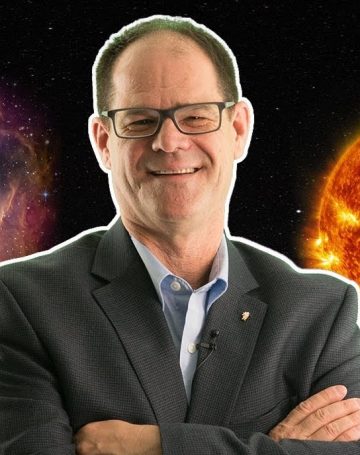
Scientist Profile

We all have been taught that stars are gaseous bodies, and to say otherwise you need pretty compelling evidence. But that is exactly what Dr. Pierre-Marie Robitaille believes he has for his hypothesis that the Sun is made of metallic hydrogen.
A Professor of Radiology at The Ohio State University from 1989 to 2019, Robitaille also argues that the background radiation associated with the Big Bang comes from the Earth’s oceans, not deep space. What makes him unusual is that his dissent grew directly out of a major mainstream achievement: building the world’s first Ultra High Field human MRI scanner.
Background
Robitaille was born in North Bay, Ontario, the third of ten children. His father, a physician, served the villages of Massey and Espanola and also cared for the Ojibway population of the region. Raised by French-Canadian parents, Pierre-Marie was schooled in French before attending Espanola High School, where teaching was in English.
He earned a degree in general science from the University of Northern Iowa in 1981, an M.S. in biochemistry from Iowa State University in 1984, and in 1986 a Ph.D. from Iowa State with majors in both zoology and inorganic chemistry. After postdoctoral work at the University of Minnesota, he joined The Ohio State University in 1989, at the age of 28, as Director of Magnetic Resonance Research. He directed MRI research there until 2000, eventually leading a $10 million laboratory, and has published more than 80 articles on applied and theoretical aspects of magnetic resonance imaging and spectroscopy.
The 8 Tesla Scanner
From 1995 to 2000, Dr. Robitaille led the design and assembly of the world’s first Ultra High Field human MRI scanner. It operates at a magnetic field of 8 Tesla, about 160,000 times the Earth’s field at sea level, doubling the previous record for MRI. Many in the field had said human imaging at such strengths was impossible. The editor of the Journal of Computer Assisted Tomography devoted a special issue to the first results, congratulating the Ohio State team “for constructing a device some experts said would be impossible to build.”
Robitaille co-edited Ultra High Field Magnetic Resonance Imaging (Biological Magnetic Resonance vol. 26, with Lawrence J. Berliner, Springer, 2006), which features a preface by Paul Lauterbur, winner of the 2003 Nobel Prize in Medicine.
Key Ideas
The turning point came from his own machine. The 8 Tesla scanner needed less radio-frequency power than expected, which led him to think of MRI as a thermal process. When he tried to work out the temperature of a human head from the laws of thermal emission, the way Penzias and Wilson had derived about 3 K for the microwave background, the answer came out at less than 1 K. Something in the standard treatment of thermal emission, he concluded, was wrong. This launched his work on Kirchhoff’s law, universality and other aspects of thermal physics.
- Kirchhoff’s law. Robitaille accepts that an opaque object at equilibrium emits as much as it absorbs. What he rejects is the claim that radiation in any cavity must be “black” no matter what the walls are made of. Real cavities, he argues, take on the character of their walls, and the correct law should be credited to Balfour Stewart.
- A liquid metallic hydrogen Sun. He argues that a true thermal spectrum requires a rigid lattice, and since the Sun emits one, it cannot be a gaseous plasma. Instead he proposes that it is condensed matter: liquid metallic hydrogen, with the photosphere marking the transition to a gaseous atmosphere.
- The microwave background. If Kirchhoff’s universality fails, Robitaille says, the 2.7 K signal need not be cosmic at all. He argues it is produced by the Earth’s oceans, and has published radiological analyses of the COBE, WMAP and Planck satellite results.
In 2002 he bought an advertisement in The New York Times announcing “The Collapse of the Big Bang and the Gaseous Sun”. The response was immediate and at times harsh. He has since published most of his thermal physics and astrophysics work in Progress in Physics, including “WMAP: A Radiological Analysis” (2007), and in 2019 co-wrote three papers on thermodynamics in astrophysics with Stephen Crothers for Physics Essays.
Mainstream astrophysics has not accepted these conclusions. Robitaille now takes his arguments directly to the public through his YouTube channel, Sky Scholar, where he lectures on thermal emission, the structure of the Sun and the history of blackbody physics.
Read more on the CNPS Wiki.

