
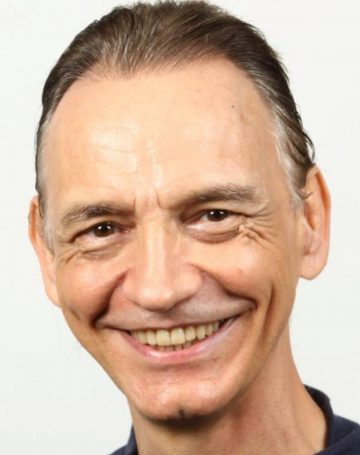
Scientist Profile


So you want to know what consciousness is? Or maybe you just want to know 50 reasons why the Big Bang is an impossible idea. Then look no further. George has a few very good ideas!
George Staniforth Coyne is a Canadian philosopher, science communicator and counsellor, best known for his book Notfinity Process and for the word in its title. He critiques relativity, the standard (Copenhagen) interpretation of quantum mechanics and the Big Bang, and offers alternatives he holds to be free of paradox and contradiction.
Background
George Coyne was born in 1952 and grew up in the Toronto area. His interest in science started at about age five, when he first tried to picture the Earth in the universe. At 11 he began questioning the conventional idea of time, and by 15 he no longer accepted that time was a flowing thing. When he went looking for sensible definitions of matter, energy and space, he couldn’t find any that made sense to him.
Just before turning 20, he moved to Vancouver on his own. At 21 he began working in youth counselling with very troubled clients, developing an approach to nonviolent self-defence based on being seen as an ally, and on hearing the urgent message he believes violent behaviour contains. He later qualified as a professional counsellor and studied Social Development at the University of Waterloo.
In his early 20s, Coyne started studying quantum mechanics and relativity. The Copenhagen interpretation, with its idea that the universe can’t exist unless someone observes or measures it, struck him as absurd. In 1981 he was drawn to David Bohm‘s interpretation of quantum mechanics because it avoided paradoxes such as wave-particle duality. He later corresponded with Bohm’s colleagues F. David Peat and Basil Hiley, whose clarification of one of his concepts appears in his book.
Key Ideas
- Notfinity. Coyne’s proposed replacement for “infinity”. He argues that no one can actually picture an infinite quantity, but anyone can deny a limit. Notfinity simply means “not finite”: the universe has no boundary, no beginning, no smallest part and no largest container.
- No invalid abstractions. His main objection to mainstream physics is that it treats abstractions as if they were real things: motion without matter, wave-particle duality, light waves in a void, superposition, cosmic expansion and inflation, and a cosmos that needs an observer to exist.
- Contradictions first. His method is to test a theory for internal contradictions first. If a theory contains contradictions, he says, it cannot be valid, however esteemed its supporters. He refuses to become emotionally invested in any theory, including his own.
- Consciousness. Coyne holds that consciousness is an abstraction for brain processes rather than a thing, that the psychological self is a program in the brain, and that the famous “hard problem” of subjective experience is not a genuine problem.
His worldview is closely aligned with the neomechanics and univironmental determinism of Dr. Glenn Borchardt, and Notfinity Process builds on Borchardt’s Infinite Universe Theory, Steven Bryant‘s Modern Mechanics, and Duncan Shaw‘s account of entanglement and aether gravity. Shaw is a close friend, and the two often talk physics on their walks together.
Work and Recognition
The first edition of Notfinity Process: Microcosms-in-Motion came out in September 2017 and topped its new-release category in the US and Canada. The second edition, Notfinity Process: Matter-in-Motion, was published by the John Chappell Natural Philosophy Society in 2021. Steven Bryant wrote that George “challenges the scientific worldview by introducing his own ideas while synthesizing thought, theories, and ideas of 21st-century physics.”
In July 2017 Coyne presented his paper “Brain, Mind, Self, and Consciousness” at the CNPS conference at the University of British Columbia, where it drew great interest. Soon after, he was invited to join the CNPS Board of Directors. He also heads the Vancouver office of the Progressive Science Institute, and was an invited participant at the 2017 David Bohm Centennial Symposium in London.
Coyne became an editor and writer for Beyond Mainstream Science in 2019. His first article, “Big Problems with the Big Bang Theory“, appeared in the premier issue, and he has discussed his ideas in several video interviews with David de Hilster.
Read more on the CNPS Wiki.

