
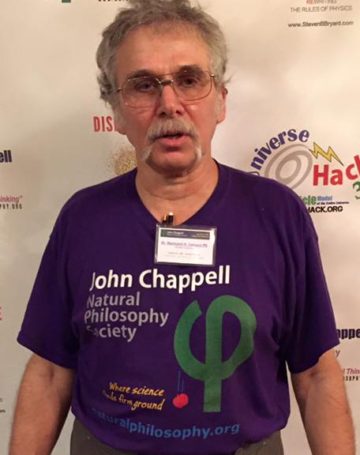
Scientist Profile
Most everyone who challenges mainstream theory works on their own theories and ideas. Raymond is different. He likes to test other dissident scientists’ theories to see if they are plausible. That is why his fellow dissidents either love him or fear him! He came into the world of dissidents through the late Dr. Paul Marmet‘s website (http://www.newtonphysics.on.ca) and the work of Stephen Crothers.
Ray is very prolific at writing scientific papers, authoring no fewer than 26 papers in four years.
Background
Raymond H. V. Gallucci was born in Albany, New York, in 1953 and lives in Frederick, Maryland. He earned his PhD in nuclear engineering from Rensselaer Polytechnic Institute in 1980, with a dissertation on how to evaluate the chance of fires knocking out safety functions at nuclear power plants. His training meant plenty of physics, especially atomic and nuclear physics, and in his university years he also got hooked on relativity, quantum physics and astronomy.
Ray is a licensed Professional Engineer who spent roughly 40 years in nuclear power, in both industry and government, including work on probabilistic safety assessment at the U.S. Nuclear Regulatory Commission. In his day job alone he has written more than 200 technical papers and journal articles.
His interest in dissident science came roaring back around 2010, when he found Marmet’s website and the work of Stephen Crothers, whose refutation of the mathematics behind black holes he credits as the moment that pulled him in. He is a charter member of the John Chappell Natural Philosophy Society (CNPS) and presented papers at its conferences from 2015 through 2019.
Key Ideas and Work
Gallucci regards black holes, the big bang and many popular theories in cosmology as incorrect. But instead of building one grand theory of his own, he takes other people’s ideas and runs the numbers, using straightforward math and order-of-magnitude reasoning to see whether they hold together. Sometimes that supports a colleague’s idea and sometimes it undermines it, which is exactly why he is both loved and feared. Most of his papers, published on the viXra archive, are short, self-contained checks of a single claim.
Some of the questions he has tackled:
- Relativity and time dilation. In papers such as “Time Dilation in Relativity” and “Alleged Extended Lifetimes of Atmospheric Muons – Does This Really Confirm Relativity?” he questions whether clock and muon results really need Einstein. He has also re-analyzed the famous 1887 Michelson–Morley experiment, arguing its “null” result has simpler readings.
- The speed of light. He asks whether light picks up the speed of its source, and proposes lab experiments that today’s equipment could do to find out. He has even weighed Bill Gaede‘s “rope hypothesis” of light against a standing-wave aether.
- Aether and gravity. He treats the aether as a live idea, asking in one paper whether the LIGO signals might be disturbances in an aether rather than ripples in spacetime. He has tested “pushing gravity” models against the solar system and assessed Duncan Shaw‘s aether concept of gravity.
- Cosmology and dark matter. He questions the Doppler reading of the cosmological redshift, and in a series titled “Who Needs Dark Matter?” offers alternative explanations for how galaxies rotate.
- Electric Universe and earth history. He has examined whether gravity could be electrical, re-examined Velikovsky, and tested James Maxlow‘s expanding-earth model from an astronomical standpoint.
In 2021 he gathered his dissident-science writings into a book, The Renegade Physicist. And just for fun, he has also proposed a statistic for measuring clutch performance in pro baseball, football and basketball.
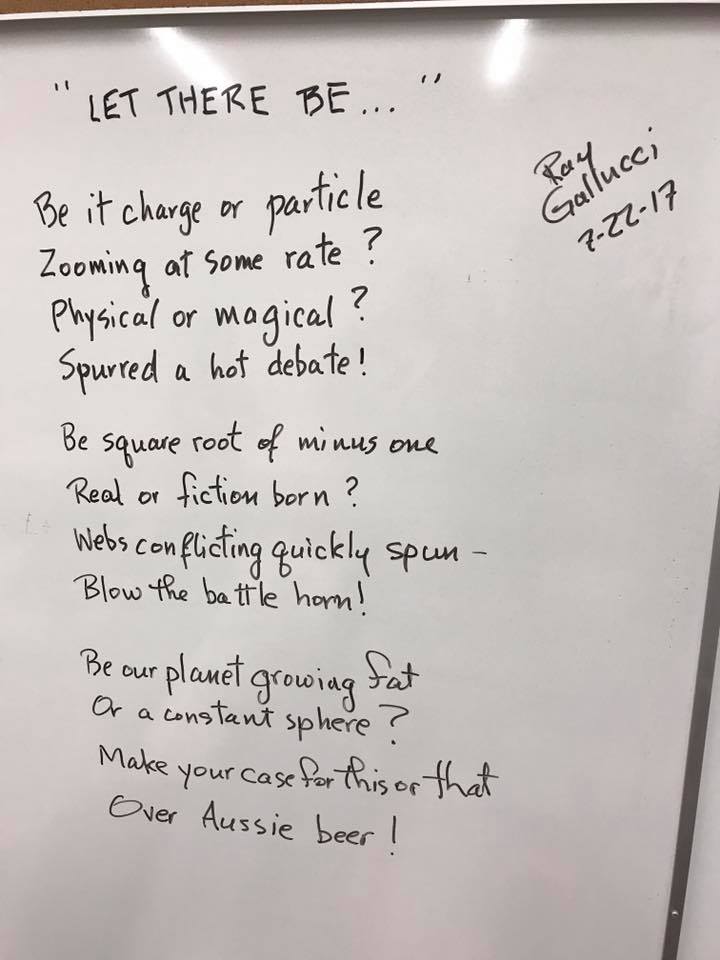
Ray is also a CNPS conference favorite for a lighter reason: he writes a poem each day of the conference, and his dissident science poems have become a fixture of the event, including one at the 2017 conference in Vancouver, Canada. At the 2018 conference his poem was “Aether Pressure,” and he played Newton opposite Robert de Hilster as Einstein in a mock trial.
Recognition
In 2019 the John Chappell Natural Philosophy Society honored Gallucci with its JCNPS Science Achievement Award.
Read more on the CNPS Wiki.

