
Problems in Mainstream Science
Point a telescope at a distant galaxy, spread its light into a rainbow, and you will find the familiar fingerprints of hydrogen, calcium and other elements sitting a little too far toward the red. Nobody disputes that. What people dispute, fiercely, is what it means. Modern cosmology reads that small shift as speed: the galaxy is rushing away, space itself is stretching, and run the film backwards and you arrive at the Big Bang.
But a measurement is not an interpretation. If red shift can be produced by something other than motion, then the expanding universe loses its foundation, and so does the age of the universe, the distance to every far-off galaxy, and much of the picture you were taught in school. Remarkably, one of the first people to say “not so fast” was the man the law is named after.
What the mainstream says
The redshift, written z, is the fractional stretch of a spectral line’s wavelength. Standard astronomy says it has three possible causes: a Doppler shift from an object’s own motion, a usually small gravitational shift, and, dominating at large distances, a “cosmological” redshift caused by the expansion of space. Light stretches while it travels because the space it travels through is growing.
The picture came together quickly. Vesto Slipher measured large velocities for spiral nebulae between 1912 and 1917, Alexander Friedmann found expanding solutions of Einstein’s equations in 1922, Georges Lemaître connected theory and observation in 1927, and Edwin Hubble published the linear redshift–distance relation in 1929, now called Hubble’s law. Because redshift is taken to measure distance, it became the yardstick for the whole universe beyond our galaxy, and the reciprocal of the Hubble constant gives the familiar age of roughly 13.8 billion years.
Defenders of the expanding universe point to more than the redshift itself: the near-perfect blackbody spectrum of the cosmic microwave background, the abundances of light elements, the stretching of distant supernova light curves by a factor of (1 + z), and the Tolman test of galaxy surface brightness. They also argue that energy-loss alternatives would blur distant images and distort the microwave background, and that no rival has yet explained all of these with one mechanism.
The problems
1. Hubble himself never bought it
Hubble was careful to separate his measurement from its meaning. Writing to Willem de Sitter in 1931 he deliberately spoke of “apparent velocities.” In 1936 he put it bluntly: if redshifts are not velocity shifts, the data show “no evidence of expansion, no trace of curvature, no restriction of the time scale,” and “the unexpected and truly remarkable features are introduced by the additional assumption that redshifts measure recession.” According to the wiki’s account, in later life he leaned toward an infinite, static universe in which redshift comes from some unrecognized principle of nature. See Edwin Hubble.
2. A straight line does not prove expansion
Critics point out that any process in which light loses a fixed fraction of its energy per distance travelled produces exactly the same linear law Hubble found. On that reading, the Hubble constant measures a rate of energy loss, not a rate of expansion. The observation alone cannot choose between the two stories. See Hubble’s law.
3. Quasars attached to nearby galaxies
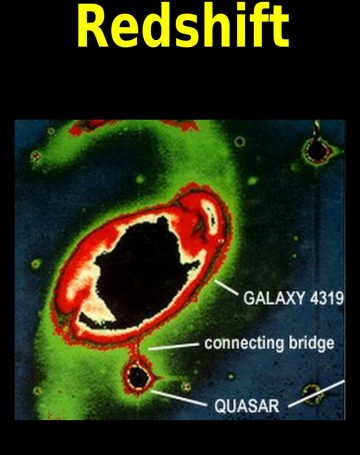
The sharpest challenge comes from astronomer Halton Arp, who catalogued many cases of high-redshift quasars that appear physically connected to low-redshift galaxies. The galaxy NGC 4319 and the object Markarian 205 appear, on Arp’s reading, to be joined by a luminous bridge. In 2005 Galianni, Arp and colleagues reported a quasar with a redshift of 2.11 lying within a few arcseconds of the nucleus of the galaxy NGC 7319 (redshift 0.0225), apparently in front of it. On the standard reading, the quasar should be some thirty times farther away than the galaxy.
If even one such link is real, Arp argued, redshift cannot be a pure distance gauge. Mainstream astronomers reply that these are chance alignments of background quasars, and that sharper images showed some bridges to be projection effects. See Intrinsic redshift and Arp’s Catalogue of Discordant Redshift Associations.
4. Quasars that are too bright to be true
Quasars flicker in brightness over days to weeks, which means the glowing region can only be light-days or light-weeks across. If they are as distant as their redshifts imply, that tiny region must outshine an entire galaxy by orders of magnitude. Critics argue the difficulty largely vanishes if quasars are much closer and far less luminous. See Quasar.
5. Redshifts that come in steps
Real recession speeds should be spread out smoothly. Yet William Tifft reported from the 1970s that galaxy redshifts cluster at preferred values, with periodicities of roughly 72 km/s. Guthrie and Napier later reported periodicities of about 37.5 and 71.1 km/s, and K. G. Karlsson found preferred quasar redshifts, the “Karlsson peaks.” Mainstream analyses attribute the effect to selection and small samples; proponents reply that the negative studies use the wrong reference frame. See Redshift quantization.
6. A “constant” that will not hold still
Hubble’s own first value, about 500 km/s/Mpc, implied a universe younger than the Earth, and the distance scale was revised downward for decades. Today measurements built from nearby stars and supernovae give about 73, while values inferred from the microwave background give about 67, a “Hubble tension” mainstream cosmology itself calls serious. Jean-Claude Pecker, Jean-Pierre Vigier and Toivo Jaakkola went further, reporting a Hubble parameter about 24 per cent higher in one half of the sky, which they read as a non-velocity redshift picked up in dense regions of galaxies. See Spatial Fluctuation of the Hubble “Constant”.
7. Galaxies that do not dim as they should
In an expanding universe, distant galaxies should look dramatically fainter per square of sky; at a redshift of 6 the expanding and static predictions differ by a factor of 343. Eric Lerner, with Renato Falomo and Riccardo Scarpa, compared Hubble Ultra Deep Field galaxies with nearby ones and reported no dimming at all, arguing that the standard model must assume galaxies shrank in just the right way to cancel the effect. The mainstream answer is that the test is passed once galaxy evolution is accounted for. See Hubble Deep Field.
8. The microwave background: predicted, or explained after the fact?
The cosmic microwave background, found by Penzias and Wilson in 1964–65, is hailed as the Big Bang’s great prediction. But Arthur Eddington, Erich Regener and Walther Nernst had obtained temperatures of a few kelvin for space on non-cosmological grounds. Harry Ricker, going back to the original papers, argued that Gamow’s 1946 paper says nothing about a microwave background and that the textbook story is a postdiction told with hindsight. See The Cosmic Microwave Background CMB.
Pierre-Marie Robitaille, who built the world’s first 8 Tesla human MRI scanner, attacks the signal itself. In WMAP: A Radiological Analysis he argues that the satellite’s maps were made by removing a galactic foreground 1,000 times stronger than the desired signal, and would not meet the standards of medical imaging. Mainstream physicists counter that the radiation’s isotropy and spectrum rule out a terrestrial origin.
Alternative explanations
Tired light. The oldest rival is nearly as old as Hubble’s law. In 1929 Fritz Zwicky proposed that photons lose energy on their long journey through interaction with matter; Richard Tolman later coined the name “tired light.” Mainstream cosmology set it aside after 1965, but it has kept developing. See Tired Light.
New Tired Light. Lyndon Ashmore argues that photons are absorbed and re-emitted by electrons in intergalactic plasma, losing a little energy each time the electron recoils. He derives both the Hubble constant and the microwave background from the same process. In Supernovae Ia Light Curves Show a Static Universe he argues that nearby supernovae show no time stretching, suggesting the universe may have expanded once but is static now.
Photon–matter interactions. Paul Marmet argued that every collision of light with atoms in intergalactic gas is slightly inelastic, so light reddens with the depth of material it crosses, and that the microwave background is simply the glow of an unlimited universe at about 3 K. Ari Brynjolfsson‘s plasma redshift claims to explain the redshift, the microwave background and the supernova data in a static universe that renews itself.
Intrinsic redshift. Arp rejected tired light altogether, noting that objects at the same distance show very different redshifts. Drawing on the variable-mass ideas of Fred Hoyle and Jayant Narlikar, he proposed that quasars are ejected from active galaxies with young, low-mass matter that is born highly redshifted, and that the redshift fades as they age into ordinary galaxies. Toivo Jaakkola answered Arp’s objections point by point in On Reviving Tired Light, a reminder that the critics disagree among themselves.
Absorption in an infinite universe. Glenn Borchardt’s Infinite Universe Theory holds that the galactic redshift is due primarily to absorption as light travels through the aether, so redshift measures distance travelled, not speed. The universe, he says, is Euclidean and not expanding.
A local microwave background. Robitaille argues that Kirchhoff’s law of thermal emission is not universal, so a 2.7 K signal need not come from the cosmos at all. He attributes it to the Earth’s oceans. Plasma cosmologists such as Eric Lerner argue instead that the background is starlight thermalized by filaments of plasma.
Critical thinkers working on this problem
- Dr. Halton Arp: the central observer of discordant quasar–galaxy redshifts, set out in “Seeing Red“.
- Dr. Pierre-Marie Robitaille: argues the microwave background comes from Earth’s oceans, not the early universe, and challenges the WMAP and COBE analyses.
- Dr. Glenn Borchardt: attributes redshift to absorption in an infinite, non-expanding universe, and offers his own “Solution to the Tired Light Theory“.
- Harry Hamlin Ricker III: traced the microwave background story back to the primary sources and argues the textbook account was told with hindsight.
- Wal Thornhill: Electric Universe leader who shared conference platforms with Arp and author of “The Universe Electric, Vol. 1: Big Bang?“, which challenges Big Bang cosmology.
Further reading on the CNPS Wiki
- Redshift: the observation, its standard reading and the main alternative mechanisms.
- Expanding Universe: the history of the idea, its evidence and its critics.
- Hubble’s law: the redshift–distance relation and why it does not require expansion.
- Edwin Hubble: the astronomer and his doubts about recession.
- Hubble Constant: the shifting value and the Hubble tension.
- Intrinsic redshift: Arp’s discordant associations and the variable-mass hypothesis.
- Quasar: the case that quasars are nearby objects ejected from galaxies.
- Redshift quantization: Tifft, Napier and Guthrie, and the Karlsson peaks.
- Tired Light: Zwicky’s idea, its mechanisms and the mainstream objections.
- Cosmic Microwave Background: discovery, the “prediction” question and alternative origins.
- The Cosmic Microwave Background CMB: Harry Ricker’s session on who really predicted it.
- WMAP: A Radiological Analysis: Robitaille’s critique of the satellite maps.
- Hubble Deep Field: “elderly galaxies” and the surface-brightness test.
- Big Bang Cosmology Meets an Astronomical Death: Marmet’s non-Doppler redshift.
- Supernovae Ia Light Curves Show a Static Universe: Ashmore on supernova time dilation.
- Plasma Redshift Cosmology: Brynjolfsson’s static, self-renewing universe.
- On Reviving Tired Light: Jaakkola’s reply to Arp’s objections.
- Infinite Universe Theory: Borchardt’s non-expanding, infinite cosmology.
Read more on the CNPS Wiki.